
Dial Any Grind by Texture: Coffee Grind Size Chart for Home Brewers
Extra-fine grinds (Turkish coffee), fine grinds (espresso), medium-fine to medium (pour-over and drip), and coarse grinds (French press and cold brew) form the backbone of any reliable coffee grind size chart. Treat those bands as starting points, not final answers. Judge texture first, taste your brew, watch the clock, and nudge the grind finer or coarser from there. This guide gives you texture anchors, approximate micron ranges, and a dialing-in method so every adjustment you make is a deliberate one, not a guess.
TL;DR:
- Grinder burr design and particle distribution significantly impact cup quality, making precise settings less reliable than texture and taste adjustments.
- Roast level and bean origin influence grind behavior, requiring minor modifications to standard settings to achieve optimal extraction.
- Consistently building a personalized grind map through small adjustments and tasting logs yields better results than relying solely on published settings.
- The quality of grinder mechanisms affects particle uniformity; cheap blade grinders produce inconsistent grounds that hinder dialing in.
- Brew method variability, recipe specifics, and equipment factors mean standard grind ranges are starting points, not fixed rules.
Table of Contents
- Coffee Grind Size Chart by Brew Method
- What Do Coffee Grind Textures Actually Feel Like?
- How Do You Dial In Your Grind Size?
- Why Grinder Settings Don’t Match Between Machines
- When Should You Break the Standard Grind Chart?
- East View Coffee’s Brewing Notes and Pairings
- Does Grind Uniformity Matter More Than Grind Size?
- How Should Roast Level and Bean Origin Change Your Grind?
- A Note on Testing and Building Your Own Map
- Try These Grind-Matched Beans From East View Coffee
- Sources
- FAQ
Coffee Grind Size Chart by Brew Method
Every brewing method pulls flavor out of coffee at a different rate, which is why one grind setting never works for everything. Water contact time, pressure, and filtration all change how fast extraction happens, and grind size is the lever you pull to match the two.
Here’s how the standard bands break down, method by method. Micron figures come from practical micron range research and should be read as approximate regions, since measurement techniques and grinder burr design shift the absolute numbers.
- Turkish coffee: extra-fine, almost powder. Roughly 40 to 220 microns. Texture resembles fine flour or cocoa powder.
- Espresso: fine. Generally fine, with a texture similar to fine table salt, sometimes finer depending on the shot recipe. Feels like fine table salt, sometimes finer depending on the shot recipe.
- Moka pot: fine to medium-fine, slightly coarser than espresso. Fine table salt to just shy of a pour-over grind works for most stovetop setups, and East View’s Moka pot grind guide puts the practical range closer to 300 to 500 microns with a 4 to 5 minute brew as your check.
- AeroPress: Ranges from medium-fine to medium-coarse, depending on the specific recipe. A short, hot, inverted brew wants a finer grind; a long steep with a paper filter can run coarser, closer to drip.
- V60 and other pour-over drippers: medium-fine. Finer-than-sand, coarser than table salt. This is the range most home brewers spend the most time dialing in.
- Chemex: medium, slightly coarser than a standard V60 pour-over, because the thick paper filter already slows the flow.
- Drip or automatic machines: medium. Similar territory to Chemex, though basket shape and flow rate on your specific machine matter.
- Siphon: medium, close to drip range, since the vacuum brew and cloth or metal filter behave similarly to a pour-over in terms of contact time.
- Cupping: medium-coarse, standardized for evaluation purposes rather than tuned to any one brewer’s palate.
- Cold brew: extra-coarse. Texture close to peppercorns. The long steep time (often 12 to 24 hours) does the extraction work that heat and pressure handle in faster methods.
Recipe details push these ranges around more than most charts admit. An AeroPress with a metal filter and a 30-second steep needs a different grind than one steeped for 3 minutes with paper. Treat every row above as the middle of a range, not a single fixed point, and adjust from there once you taste the result.
What Do Coffee Grind Textures Actually Feel Like?
Numbers on a chart don’t mean much until you’ve felt the grind between your fingers. Texture anchors give you a reference you can check anywhere, with no scale or caliper required.
- Extra-fine feels like flour or powdered sugar. This is Turkish coffee territory, fine enough to cling to your fingertips.
- Fine feels like table salt. This is your espresso and stovetop Moka pot zone.
- Medium-fine feels finer than beach sand but grittier than table salt. Pour-over dialing usually lands here.
- Medium feels like a coarser table salt, closer to coarse sand. Drip machines and Chemex both sit around this texture.
- Medium-coarse feels like coarse sand, distinctly gritty and visible as individual particles.
- Coarse feels like sea salt or kosher salt, chunky and easy to see without a magnifier.
- Extra-coarse feels like cracked peppercorns. Cold brew lives here.
Three quick checks help you confirm where your grind actually sits. The pinch test has you roll a small amount between your thumb and forefinger to judge grit versus powder. The paper test spreads a spoonful across a white sheet so you can see particle size and how evenly it’s distributed. A simple flashlight check held at an angle across the spread grounds reveals shadows and clumps that flat overhead light hides.
Particle distribution matters as much as average size. Every grind produces some fines (dust-like particles) and some boulders (oversized chunks), and tools built to measure that spread show that a wider mix pulls in two directions at once. Fines over-extract fast and turn bitter; boulders under-extract and taste sour or thin. A grind chart from Notabarista treats this uneven distribution as one of the biggest hidden causes of a muddy or unbalanced cup, even when the average grind size looks correct on paper.
How Do You Dial In Your Grind Size?
Start from the chart’s texture target for your method, then change exactly one variable before you brew again. Grind size, dose, and water temperature all shift extraction, and adjusting more than one at a time makes it impossible to know which change actually fixed (or wrecked) the cup.
Taste tells you which direction to move.
- Sour, sharp, or watery: under-extracted. Grind finer, extend contact time, or raise water temperature slightly.
- Bitter, harsh, or muddy: over-extracted. Grind coarser, shorten contact time, or lower the dose.
- Flat or hollow despite a “correct” grind: check your water temperature and freshness of the beans before touching the grinder again.
Brew time works as a diagnostic baseline, not a rule to force. A V60 that finishes well outside the typical 2:30 to 3:30 window is usually signaling a grind or dose problem, but recipe and roast level shift that window too, so let taste make the final call rather than chasing a stopwatch number.
Pro Tip: Keep a small log with four columns: grind setting, dose, water temp, and tasting notes. Two or three logged tests almost always reveal the pattern faster than memory alone.
Move in small steps. One or two clicks on a manual grinder, or a similarly small nudge on a stepless model, is usually enough to notice a real difference. Jumping several steps at once, as dialing-in guidance from Mahlkönig points out, tends to overcorrect and send you chasing your tail between two bad extremes.
Why Grinder Settings Don’t Match Between Machines
A “12” on one grinder means nothing on another. Burr geometry, the number of adjustment steps between settings, and even how a manufacturer numbers its dial all differ from one machine to the next, which is exactly why grind setting numbers aren’t transferable across grinders. A flat-burr grinder and a conical-burr grinder can hit the same texture at completely different numbers.
Build your own map instead of borrowing someone else’s settings. This four-step approach works on nearly any grinder:
- Pick a texture target from the chart above, matched to your brew method.
- Record your current setting before you touch anything, so you have a starting reference point.
- Move in small steps, one or two clicks at a time, tasting after each change.
- Log the result next to the setting number, and repeat for each method you brew regularly.
After a few sessions, you’ll have a personal settings chart for your specific grinder. That’s worth more than any published number, though it’s still smart to check the manufacturer’s documentation first if your grinder came with recommended ranges. Use those as a rough starting point, then let texture and taste finish the job.
When Should You Break the Standard Grind Chart?
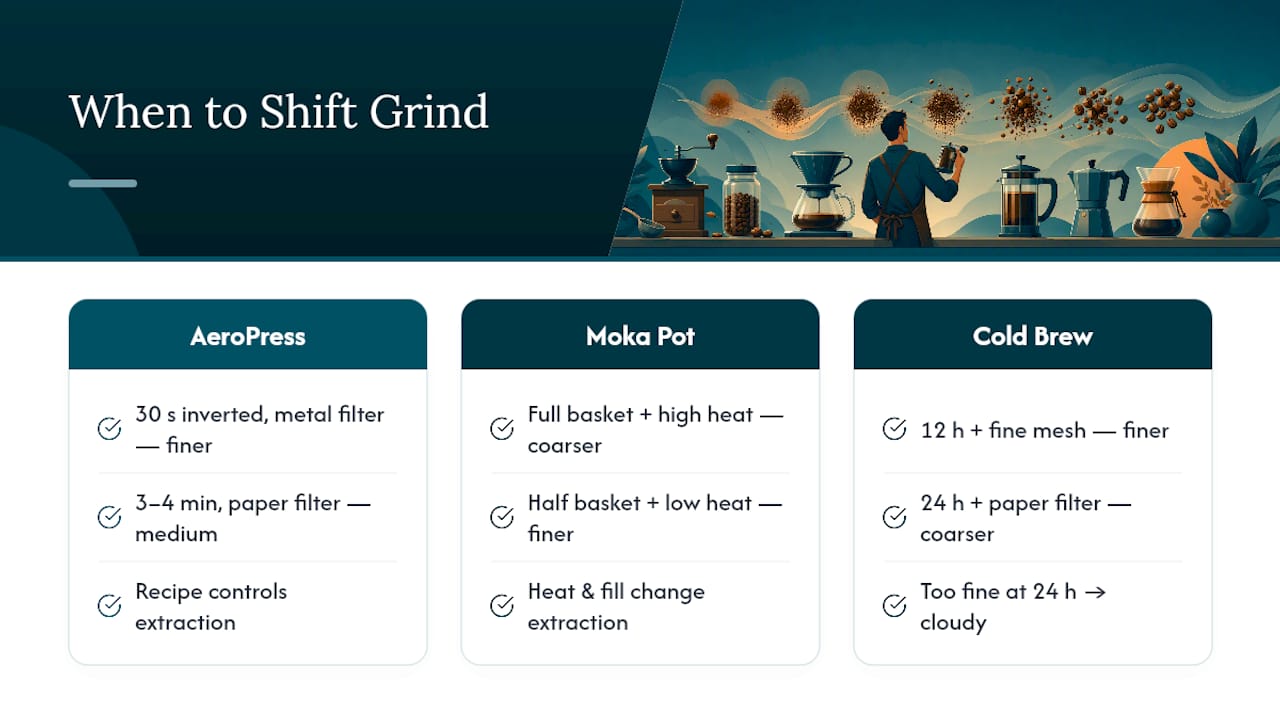
Some methods have recipes flexible enough that the “standard” grind band is really just a midpoint. AeroPress is the clearest example: a fast, inverted, 30 second steep with a metal filter behaves almost like an espresso pull and wants a finer grind, while a 3 to 4 minute steep with a paper filter behaves more like a small pour-over and wants something closer to medium. Treating AeroPress as one fixed grind ignores how much the recipe itself controls extraction.
Moka pot brewers run into a similar issue with heat and basket fill. A fuller basket and higher heat pull faster and can tolerate, or even need, a slightly coarser grind to avoid bitterness. A half-full basket on lower heat often needs a touch finer grind to avoid an under-extracted result.
Cold brew comes with its own trade-off between steep time, grind, and filtration. A shorter 12 hour steep with a fine mesh filter can use a slightly finer grind than a full 24 hour steep through a paper filter, because the longer contact time and coarser filtration both push toward a smoother, less sediment-heavy result. Push the grind too fine on a 24 hour steep and you’ll fight cloudy, over-extracted cold brew every time.
East View Coffee’s Brewing Notes and Pairings
East View Coffee Company built its Brewing Guide around the same texture-first approach outlined here, because a chart only helps if it gets tested against a real cup. The Moka pot page above and the French press ratio breakdown both walk through grind, dose, and timing side by side rather than treating grind size as an isolated number.
Beans matter as much as grind setting. East View roasts every batch small in Kenosha, Wisconsin, sourcing exclusively from women-owned farms and paying premium rates that support agricultural equity on the ground. For espresso and Moka pot brewing, the Espresso Blend is built to hold up under fine grinds and short contact time. For cold brew, the Cold Brew Blend is roasted with the long steep and coarse grind in mind, so it stays smooth instead of muddy after 24 hours. A broader pairing guide covers the rest of the lineup by method.
Does Grind Uniformity Matter More Than Grind Size?
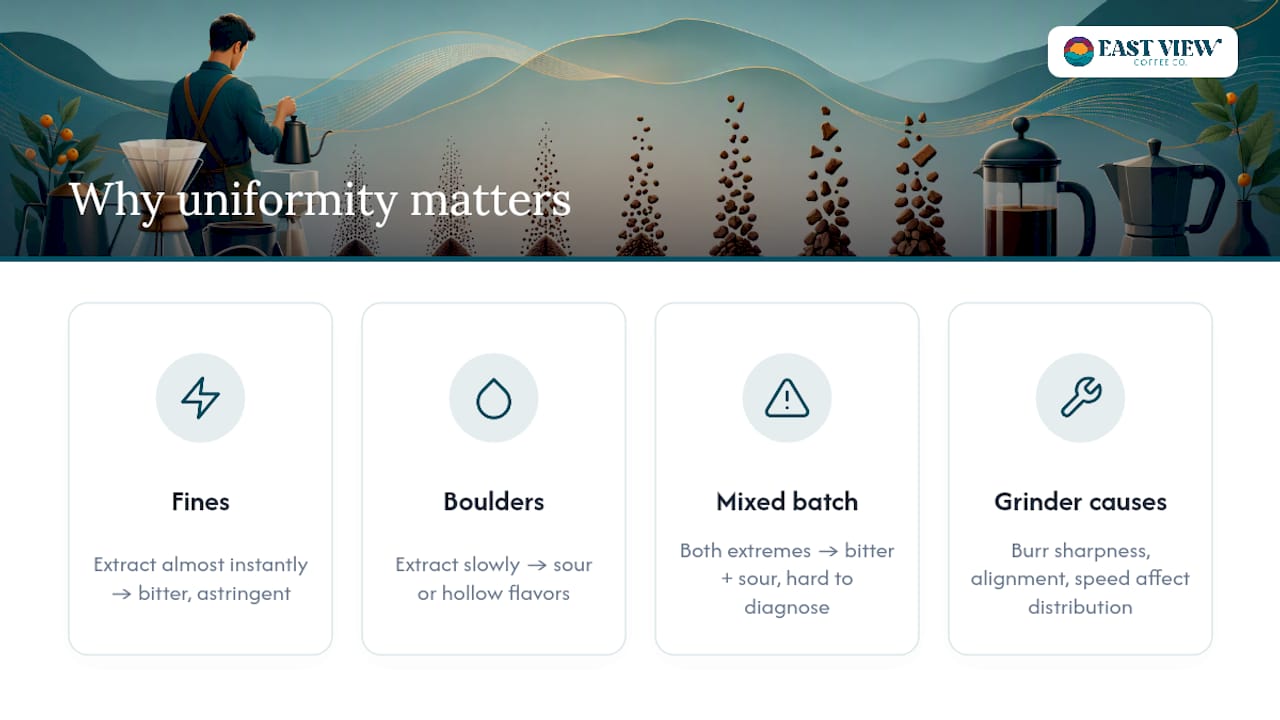
Grind size gets all the attention, but uniformity is often the bigger problem hiding underneath a “correct” setting. Two grinders set to the same average particle size can produce very different cups if one throws off a wide spread of fines and boulders while the other produces a tight cluster around the target size.
Fines extract almost instantly because of their tiny surface area, often turning bitter and astringent before the rest of the grounds have caught up. Boulders extract slowly and can taste sour or hollow even in a properly timed brew. When both extremes show up in the same batch, you get a cup that’s simultaneously bitter and sour, which is a much harder problem to diagnose than a simple “too fine” or “too coarse” mistake.
This is where grinder quality separates itself from grinder price alone. Burr sharpness, burr alignment, and even grind speed all affect how tight that particle distribution is. A cheap blade grinder produces wildly inconsistent particle sizes no matter what setting you use, which is why chasing the “right” number on a blade grinder rarely fixes a bad cup. A quality burr grinder, even a modest one, gives you a tighter distribution to work with, and that consistency is what makes dialing in by taste actually reliable. If your cup tastes muddy despite careful grind and timing adjustments, the grinder itself, not the setting, is often the real culprit.
How Should Roast Level and Bean Origin Change Your Grind?
Darker roasts are more brittle than light roasts, and that brittleness changes how they behave at the same grind setting. A dark roast ground to the same number as a light roast typically produces more fines, because the bean structure fractures more easily. If a dark roast tastes bitter or harsh at your usual pour-over setting, try going slightly coarser before you assume the recipe is wrong.
Light roasts are denser and more resistant to grinding, which means they often need a slightly finer setting than a dark roast to hit the same extraction level in the same brew time. This is part of why a “medium” grind on a chart can taste sour with a light roast and fine with a medium roast on the exact same grinder.
Bean origin adds another layer worth watching. Naturally processed coffees and beans with lower density, common in some Ethiopian and Central American lots, tend to fracture differently than washed, denser beans from origins like parts of Colombia or Kenya. The practical takeaway isn’t a separate chart for every origin. It’s to treat roast level and bean density as reasons to nudge your grind slightly, using the same taste and time diagnostics covered earlier. Freshness plays a role here too, since bean selection and roast date both affect how predictably a given grind setting behaves from bag to bag.
A Note on Testing and Building Your Own Map
The single biggest improvement most home brewers can make isn’t a better grinder. It’s changing one variable at a time and writing down what happened. A grind chart gets you in the right neighborhood; a simple log of setting, dose, and tasting notes gets you the rest of the way, faster than trial and error ever will.
Share your grinder model and the settings that worked for you. Community notes like these, stacked across enough brewers and machines, do more to refine a grind chart than any single lab measurement ever could.
— Jenny
Try These Grind-Matched Beans From East View Coffee
Getting the texture right only pays off with beans worth dialing in for. East View Coffee Company roasts every batch small in Kenosha, Wisconsin, sourcing exclusively from women-owned farms and paying premium rates that support agricultural equity at the source, not just a marketing line on the bag.
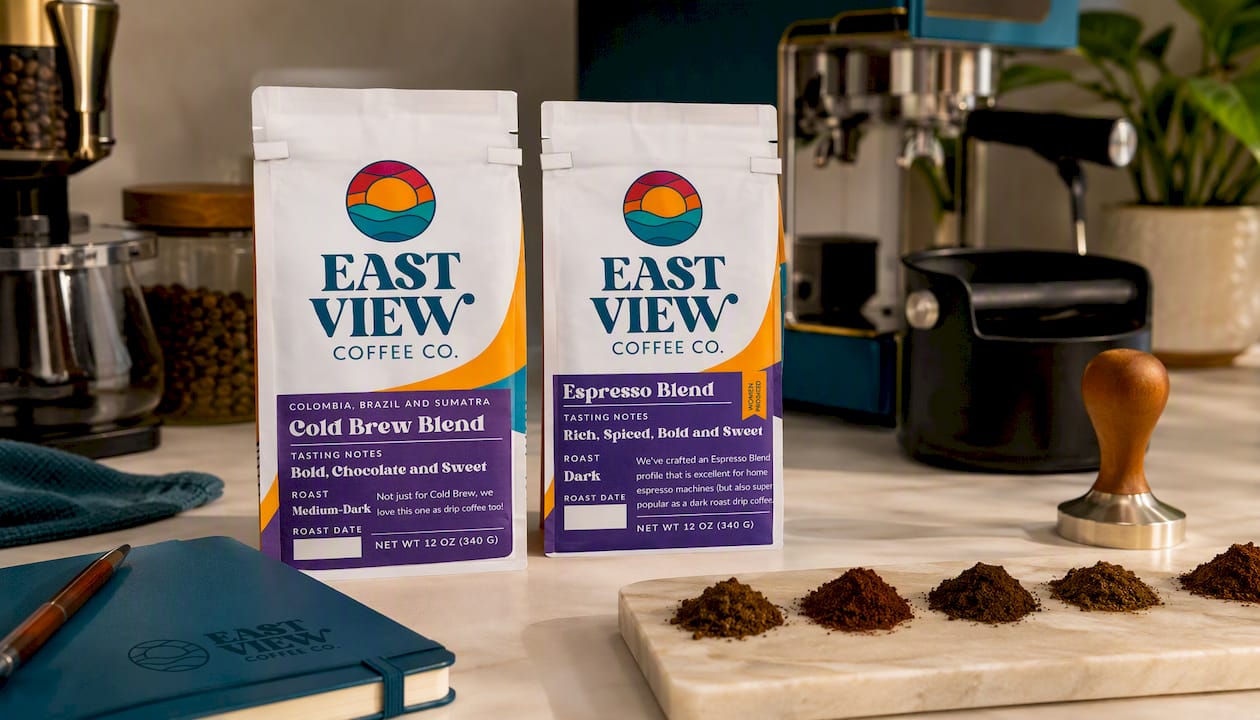
If espresso or Moka pot is your daily method, the Espresso Blend is roasted to hold structure under a fine grind and short contact time, which is exactly where a lot of home shots fall apart. Running cold brew instead? The Cold Brew Blend is built for that long steep and coarse grind, so it stays smooth instead of muddy after a full 24 hours. Not sure which roast fits your brewer yet? The Coffee Subscription is a straightforward way to rotate through East View’s roasts, including the Dark & Bold and Light & Bright lineups, and figure out what your grinder and your palate actually prefer. Pick a blend, set your grind, and taste the difference for yourself.
Sources
The grind bands and texture anchors in this guide draw on the Coffee Grind Size Chart from Coffee Lab Advisor for method-by-method starting points, and the practical micron range breakdown from Notabarista for approximate particle-size figures. Dialing-in guidance and the one-variable-at-a-time protocol come from Mahlkönig’s grind optimization notes, while brew-time baselines for pour-over reference Better Coffee Lab’s V60 timing guide. Background on method distinctions comes from the World Brewers Cup competition format.
- Coffee Grind Size Chart (2026): By Brew Method
- Coffee grind size chart – practical micron ranges
- Optimize grind size settings (Mahlkönig blog)
- How long should a V60 brew take? (Better Coffee Lab)
FAQ
What should my coffee grind size be?
It depends entirely on your brew method: extra-fine for Turkish coffee, fine for espresso, medium-fine to medium for pour-over and drip, and coarse for French press or cold brew, according to the standard grind size chart. Use that as your starting texture, then adjust finer or coarser based on taste and brew time.
What grind of coffee gives the best flavor?
There’s no single best grind. The right one matches your brewing method and produces a balanced cup that’s neither sour (under-extracted) nor bitter (over-extracted). A well-matched grind on quality beans, like East View’s Espresso Blend for espresso or the Cold Brew Blend for cold brew, gives the roast’s flavor the best chance to come through.
How many microns is a medium grind?
Medium grind sizes for drip and Chemex generally fall in the coarse sand range, while espresso runs closer to 180 to 380 microns and Turkish coffee down to 40 to 220 microns, per approximate micron range data. These figures are approximate since grinder type and measurement method both affect the actual number.
Why does my French press coffee taste muddy?
Muddy French press coffee usually means the grind is too fine, letting fines pass through the mesh filter, or the particle distribution is uneven with too many fines mixed into a coarser batch. Try a coarser, sea-salt-textured grind and check East View’s French press ratio guide for a tested 1:15 brew ratio.
Do I need a different grind for dark roast versus light roast coffee?
Dark roasts fracture more easily and often need a slightly coarser grind than light roasts at the same brew method to avoid bitterness. Light roasts are denser and can need a touch finer setting to reach full extraction in the same brew time.