
Dial In 1:15 French Press Ratio With Roaster Tested Brew Chart
Use approximately a 1:15 coffee to water ratio by weight as your starting point, meaning about 1 gram of coffee for every 15 grams (or milliliters) of water. For a standard 34-ounce French press, the coffee amount scales accordingly. If you don’t own a scale, a rounded tablespoon of coarse coffee weighs about 5 to 6 grams, but weighing will always beat scooping.
TL;DR:
- Using a 1:15 coffee-to-water ratio provides a balanced extraction, but adjusting slightly towards 1:14 can boost body for lower-acid or full-bodied beans.
- Water temperature should stay between 195–205°F, with a 4-minute steep time; higher elevations or cooler water may require slight timing adjustments.
- Weighing coffee with a scale ensures consistency, as a tablespoon of coarse grounds varies between 5 and 6 grams, making the difference in flavor.
- Press the plunger slowly and decant immediately to avoid over-extraction and a gritty, muddy taste caused by fines suspension.
- Water quality significantly influences extraction; filtered or spring water with balanced minerals offers the best flavor without unnecessary ratio adjustments.
Table of Contents
- Why the 1:15 French Press Ratio Works
- Scalable Brew Chart: Grams and Tablespoons by Press Size
- The Step-by-Step 1:15 French Press Recipe
- How to Fix a Weak, Bitter, or Gritty Cup
- Equipment and Measuring Tips That Actually Matter
- East View Coffee: Brewing Experience Behind the Numbers
- Does Water Quality Change Your French Press Ratio?
- Does Altitude Affect Your French Press Ratio?
- A Quick Three-Shot Test to Find Your Ratio
- Why Cold Brew Blend Coffee Is Worth Trying in a French Press
- Sources
- FAQ
Why the 1:15 French Press Ratio Works
Full-immersion brewing keeps every coffee particle soaking in the same water for the entire steep, unlike pour-over, where fresh water constantly moves through the grounds. That constant contact pulls flavor faster and more evenly, which is exactly why most guides land on 1:15 as the practical sweet spot for a French press coffee ratio rather than the leaner 1:16 or 1:17 ratios you see with drip machines.
Temperature and time do the rest of the work. Water that’s too cool under-extracts and tastes flat; water that’s too hot pulls out bitter compounds along with the good stuff.
Water temperature for French press: 195–205°F (90–96°C) is the range that extracts flavor fully without scalding the grounds, according to ESPRO’s brewing guidance. Pair that with a standard 4-minute steep and you’re typically landing in the 19 to 22 percent extraction range that tastes balanced in most home setups, per the Pulled Journal’s brewing breakdown.
When a cup tastes off, adjust in this order, not all at once:
- Ratio first (add or subtract a gram or two of coffee)
- Grind size second (finer for more extraction, coarser for less)
- Time and temperature last (small nudges, not big swings)
Our own temperature guide by brew method breaks down why French press tolerates a slightly wider temperature window than something like pour-over, where precision matters more.
Scalable Brew Chart: Grams and Tablespoons by Press Size
Once you know your press size, the math is simple: multiply the water weight in grams by 1 divided by your target ratio. Here’s the breakdown for the most common French press sizes, with coffee amounts at 1:14 (stronger), 1:15 (standard), and 1:17 (lighter).
| Press Size | Water (g) | Coffee at 1:14 | Coffee at 1:15 | Coffee at 1:17 | Approx. Tablespoons (1:15) |
|---|---|---|---|---|---|
| 240 ml (8 oz) | 240 g | 17 g | 16 g | 14 g | 3 tbsp |
| 350 ml (12 oz) | 350 g | 25 g | 23 g | 21 g | 4 tbsp |
| 475 ml (16 oz) | 475 g | 34 g | 32 g | 28 g | 5.5 tbsp |
| 950 ml (32 oz) | 950 g | 68 g | 63 g | 56 g | 11 tbsp |
Tablespoon figures assume roughly 5 to 6 grams per rounded scoop of coarse coffee, a conversion worth treating as an estimate rather than gospel. A kitchen scale accurate to 1 gram removes the guesswork entirely, and it’s the difference between a repeatable cup and a different coffee every morning.
The Step-by-Step 1:15 French Press Recipe
You need a French press, a burr grinder set to coarse (think breadcrumbs, not sand), a scale, and a kettle. Here’s the timed sequence:
- Add coarse coffee to the empty press, measured approximately by weight using your chosen ratio (commonly starting near 1:15).
- Pour water heated to a range that extracts flavor without scalding the grounds (about 195 to 205°F, or 90 to 96°C) over the grounds, saturating evenly. Start a timer.
- After about 30 seconds, give the slurry one gentle stir to knock loose any dry clumps.
- Let it steep undisturbed for about four minutes.
- Place the plunger on top and press down slowly over approximately 15 to 20 seconds.
- Immediately decant into a separate container or mug to avoid over-extraction.
Pro Tip: Press slowly and decant right away. A fast plunge kicks fines into suspension, which is the single biggest cause of a gritty, muddy-tasting cup, according to Tasting Table’s brewing research.
Our full brewing guide walks through grind settings by roast if you want more detail on dialing in a specific bag.
How to Fix a Weak, Bitter, or Gritty Cup
Diagnose before you change anything. A few grams in the wrong direction, or a grind adjustment made blindly, just muddies the next test.
- Weak or watery: Add 1 to 2 grams of coffee per 300 to 500 ml of water, nudging toward 1:14. If it’s still thin, grind slightly finer.
- Bitter or harsh: Coarsen the grind or shave 30 seconds off the steep time before touching the ratio. Big ratio jumps mask the real problem.
- Gritty or muddy: Decant immediately after pressing, switch to a coarser grind, or check whether your filter mesh has stretched. Leave the ratio alone here; grit is almost always a technique issue, not a measurement one.
Change one variable at a time and jot down what you tried. Coffee professionals consistently recommend logging single adjustments, because changing grind and ratio in the same brew tells you nothing about which one actually fixed the cup.
Equipment and Measuring Tips That Actually Matter
A digital kitchen scale is the single highest-leverage purchase for consistent French press coffee. Scoops vary by bean density and grind size; grams don’t.
- 1 tablespoon of coarse coffee ≈ 5 to 6 grams, useful as a fallback, not a habit
- Boil water, then let it sit off the heat for about 30 seconds to land in the 195 to 205°F range without a thermometer
- Pour in a slow, even circular motion to saturate all the grounds at once
- Stir once at the 30-second mark, then leave it alone until you press
Pro Tip: Keep a short brew journal, even just notes in your phone. Two lines per brew (ratio, grind setting, tasting note) turn weeks of guessing into a dialed-in recipe within a handful of tries.
East View Coffee: Brewing Experience Behind the Numbers
Small-batch roasting means we taste every lot before it ships, and the 1:15 baseline holds up across nearly every roast profile we work with, from bright washed lots to heavier natural processes.
Certain coffee blends with a lower-acid, chocolate-forward profile may lean slightly toward the 1:14 side of the range if you want more body, but 1:15 keeps it balanced without tipping heavy.
Does Water Quality Change Your French Press Ratio?
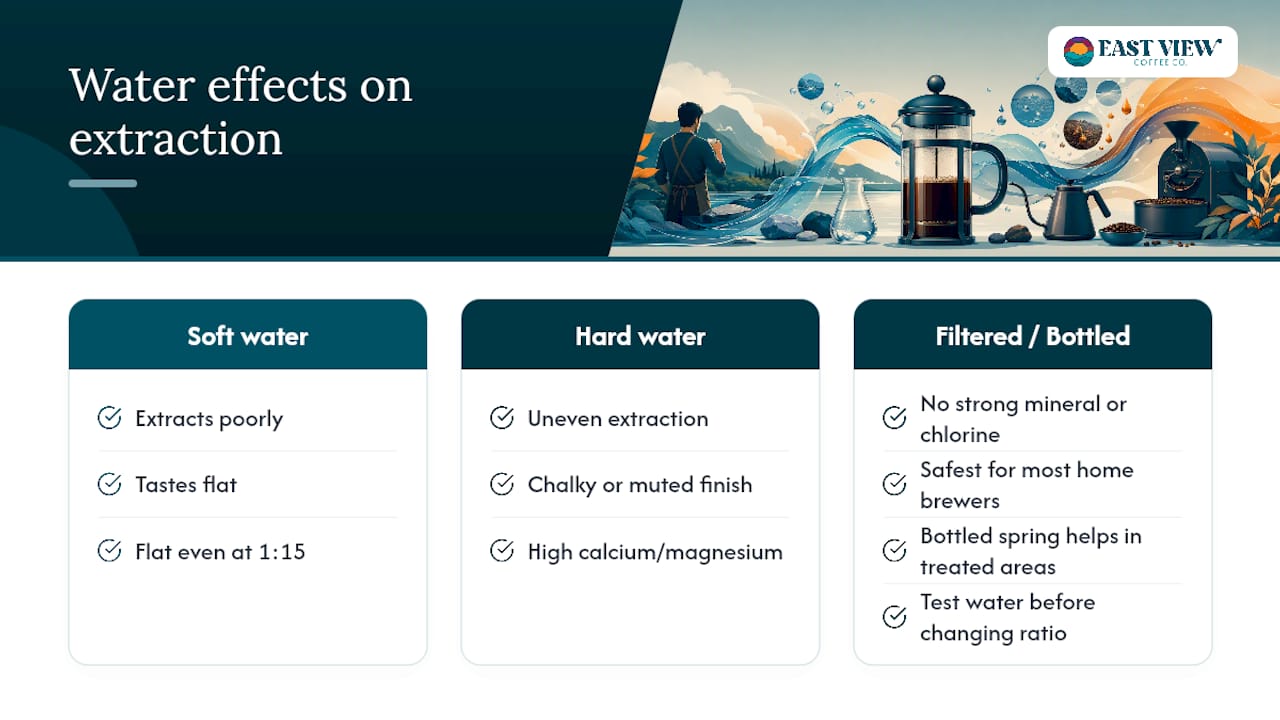
Water makes up roughly 98 percent of your cup, so its mineral content directly affects how much flavor it can pull from the grounds. Water that’s too soft, stripped of minerals through heavy filtration or reverse osmosis, extracts poorly and tastes flat even at a textbook 1:15 ratio. Water that’s too hard, loaded with calcium and magnesium, can extract unevenly and leave a chalky or muted finish.
If your tap water tastes off on its own, it will taste off in your coffee, ratio be damned. Filtered water without a strong mineral or chlorine taste is the safest bet for most home brewers. Bottled spring water often works better than tap in areas with heavily treated municipal supplies, though it’s not a universal fix.
Here’s the practical adjustment: if you switch water sources and your cup suddenly tastes weaker or more sour, don’t immediately blame your ratio. Try the same ratio with a different water source first. Only after confirming the water isn’t the variable should you start nudging grams. Skipping this step is one of the most common reasons home brewers chase a “perfect ratio” that was never actually broken, when the real culprit was sitting in the tap the whole time.
Does Altitude Affect Your French Press Ratio?
Water boils at a lower temperature as elevation increases, which matters more for French press brewing than most people assume. At sea level, water boils at 212°F. At 5,000 feet, it boils closer to 203°F, already at the low end of the ideal 195 to 205°F brewing window straight out of the kettle.
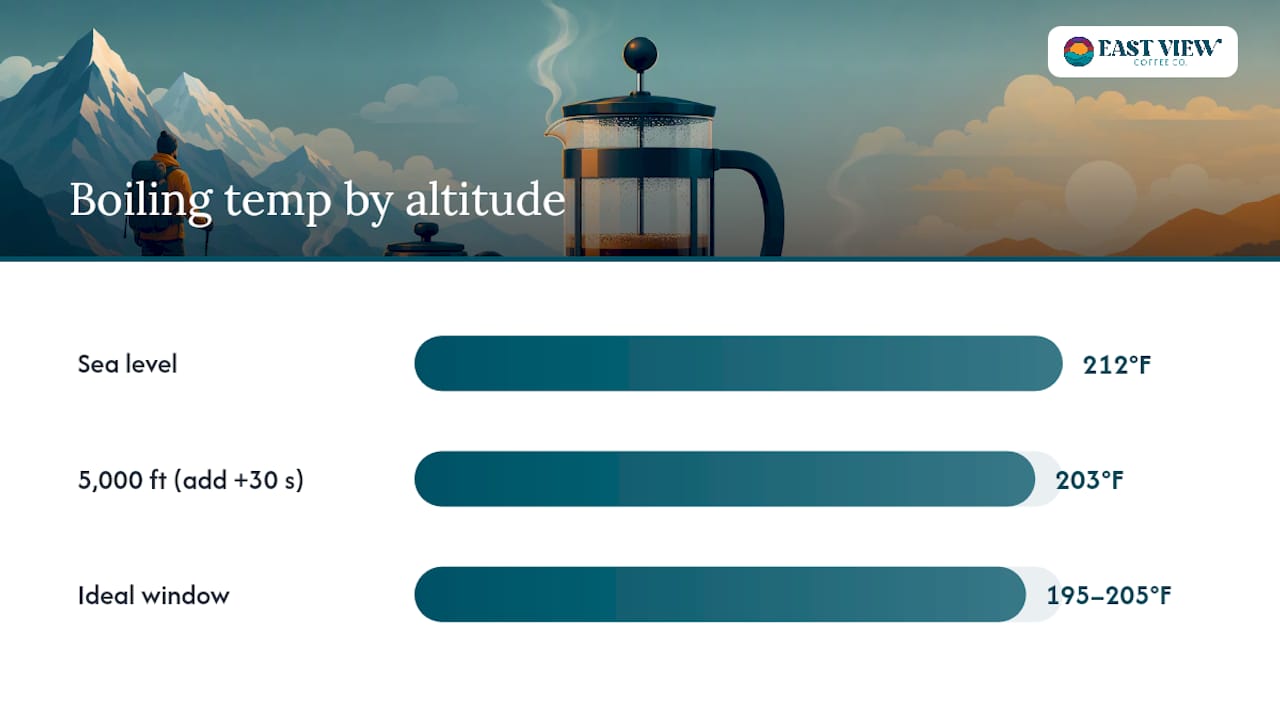
At higher elevations, above roughly 5,000 feet, water may struggle to reach even the low end of that range after the usual 30-second rest off the boil. The practical fix is to skip the rest period entirely and pour closer to the boiling point, since the water is already cooler than it would be at lower elevations.
Extraction also happens slightly slower at lower atmospheric pressure, which is a small effect but a real one. If you’re brewing above 5,000 feet and your cup consistently tastes under-extracted at your usual 4-minute steep, try adding 30 seconds to the timer before touching your ratio. Altitude changes the brewing environment, not the fundamentals of extraction, so the 1:15 starting point still applies. You’re just compensating for a slightly cooler, slower system to get there.
A Quick Three-Shot Test to Find Your Ratio
Brew three identical batches back to back: same grind, same 4-minute time, same water, but at 1:17, 1:15, and 1:13. Taste them side by side, cold as that sounds, and pay attention to body, clarity, and where bitterness creeps in. A darker roast or a bag past its ideal window will usually push you toward the leaner end.
— Jenny
Why Cold Brew Blend Coffee Is Worth Trying in a French Press
Cold Brew Blend Coffee wasn’t built exclusively for cold brew. Its low-acid, full-body profile is exactly what full-immersion brewing rewards, since a French press already produces a heavier cup than a paper filter method by design. Brew it hot at 1:15 with a coarse grind and the standard 4-minute steep, and you get a rounded, chocolate-forward cup with almost none of the sharpness you’d expect from a brighter roast.
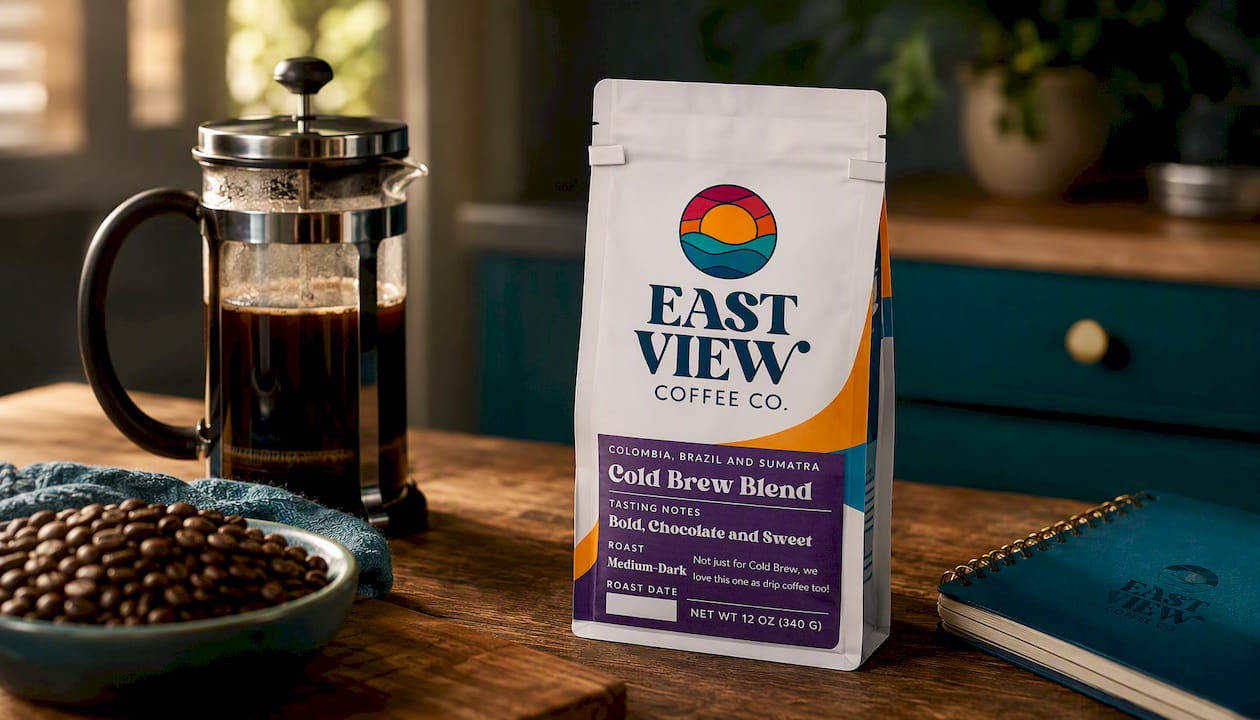
This blend comes from women-owned farms and is roasted in small batches, sourced with fair pay built into the price, not added as an afterthought. If you’re not ready to commit to a full bag, grab a sample size and run your own three-shot test at home. Ready to try it in your own press? Order the Cold Brew Blend and start with 63 grams per liter of water.
Sources
Coffee to Water Ratio for French Press – ESPRO French Press Ratio: The Complete Guide – Pulled Journal How to Make Better French Press Coffee – Serious Eats French Press Ratio: How Much Coffee Per Cup – Barista At Home
- Coffee to Water Ratio for French Press: Get It Right Every Time – ESPRO
- French Press Ratio: The Complete Guide to Coffee, Water, and Time | Pulled Journal
FAQ
What’s a good ratio for French press coffee?
A 1:15 ratio by weight, meaning 1 gram of coffee per 15 grams of water, is the standard starting point most guides recommend, with a workable range between 1:12 and 1:17 depending on taste.
How much coffee for 1 cup of French press?
For a single 8-ounce (240 ml) serving, use about 16 grams of coffee, roughly 3 tablespoons of coarse grounds, at the standard 1:15 ratio.
How many tablespoons of coffee for 4 cups of French press?
A 4-cup French press (about 950 ml of water) needs roughly 63 grams of coffee at 1:15, which works out to about 11 tablespoons of coarse grounds, though weighing on a scale is far more accurate than counting spoons.
How do I make 2 cups of coffee in a French press?
For roughly 475 ml (16 ounces) of water, weigh out 32 grams of coffee at 1:15, steep for 4 minutes at 195 to 205°F, then press slowly and decant right away.
How long should French press coffee steep?
Four minutes is the standard steep time at 1:15, though you can shorten it slightly if the cup tastes bitter or extend it slightly if it tastes weak.