
3 Questions for Coffee Shoppers: Rainforest Alliance vs Fair Trade
Fairtrade guarantees producers a minimum price and a community premium on top of the market rate. Rainforest Alliance guarantees a farm meets environmental, labor, and management standards, and asks buyers to pay a Sustainability Differential rather than a fixed floor price. If your priority is direct income protection for farmers, Fairtrade is the closer match. If it’s environmental stewardship and supply-chain traceability, Rainforest Alliance fits better.
TL;DR:
- Rainforest Alliance certifies larger farms and supply chains, emphasizing environmental standards and traceability through digital tracking platforms.
- Fairtrade guarantees a fixed minimum price and premium for smallholder cooperatives, focusing on direct income protection and community investments.
- Neither seal fully guarantees both fair pay and environmental sustainability; verification often requires checking specific sourcing details and codes.
- Certification costs and structures can favor bigger producers for Rainforest Alliance, while Fairtrade benefits depend heavily on cooperative organization and price depressed markets.
- Brands that provide transparent sourcing information, including cooperative names and traceability codes, offer more reliable proof of ethical practices than relying solely on accreditation logos.
Table of Contents
- Rainforest Alliance vs Fair Trade at a Glance
- How Fairtrade Works: Minimum Price, Premium, and Cooperative Control
- How Rainforest Alliance Works: Standards, Payments, and Traceability
- Which Certification Delivers Better Farmer Outcomes?
- Are These Certifications Actually Trustworthy?
- How to Choose Between the Two Labels
- How East View Coffee Applies This Guide When Sourcing
- Historical Background of Both Certifications
- Where Each Certification Operates Around the World
- Environmental Impact Beyond the Farm Gate
- Labor Rights and Community Benefits Under Each Standard
- Certification Costs Producers Actually Pay
- What Actually Matters When You’re Standing in the Coffee Aisle
- A Values-Aligned Option If You Want Both Priorities Covered
- Sources
- FAQ
Rainforest Alliance vs Fair Trade at a Glance
Both seals show up on the same shelf, sometimes on the same bag, but they’re built to answer different questions. Here’s the fast version before the deeper mechanics:
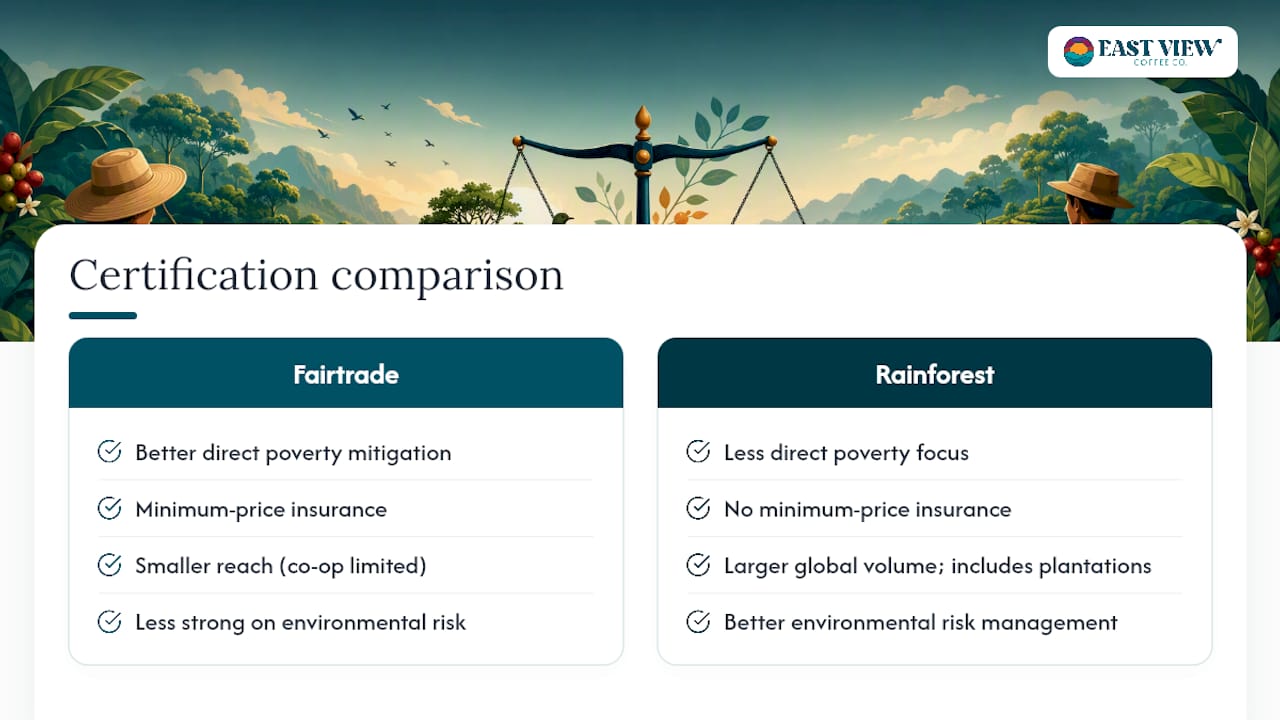
- Primary focus: Fairtrade centers on economic justice through price floors; Rainforest Alliance centers on farm-level sustainability and risk management.
- Farmer income mechanism: Fairtrade uses a guaranteed minimum price plus a fixed premium; Rainforest Alliance uses a negotiated Sustainability Differential plus optional Sustainability Investments.
- Scale and typical buyers: Rainforest Alliance certifies far greater volume and fits large plantations and multinational supply chains, while Fairtrade concentrates on smallholder cooperatives.
- Traceability: Rainforest Alliance runs digital chain-of-custody tools (MyRA and RACP); Fairtrade relies more on cooperative-level auditing and premium reporting.
- What the seal actually guarantees: Fairtrade guarantees a price floor was paid; Rainforest Alliance guarantees a farm passed an audited sustainability standard.
Note the wording: “Fairtrade” is the certification body and seal; “fair trade” (lowercase) is often used loosely by brands to describe any ethically sourced product, certified or not. Plenty of coffee bags carry both seals at once, since the two systems address different gaps rather than competing head-to-head.
How Fairtrade Works: Minimum Price, Premium, and Cooperative Control
Fairtrade’s core mechanism is a floor. If the market price for coffee drops below Fairtrade’s set minimum, buyers still have to pay that minimum. When the market price rises above it, buyers pay market price plus a fixed premium on top. That premium doesn’t go into an individual farmer’s pocket automatically. It flows to the cooperative, which votes democratically on how to spend it.
Common uses of premium funds include:
- Building or repairing schools and clinics
- Financing clean water infrastructure
- Funding processing equipment upgrades
- Covering training programs for cooperative members
Fairtrade’s model builds shared infrastructure, not identical individual payouts. A cooperative might spend its premium on a new water system that benefits every household in the village, even though not every farmer sees the same cash bump. Fairtrade International’s own comparison notes the minimum price and premium system was designed specifically for producers who are marginalized within volatile commodity markets. The catch: it works best where cooperatives are well organized and prices are genuinely depressed. It does less for farmers who aren’t part of a certified cooperative structure in the first place.
How Rainforest Alliance Works: Standards, Payments, and Traceability
Rainforest Alliance certification doesn’t set a price floor. It certifies that a farm meets a detailed standard covering deforestation, biodiversity protection, agrochemical use, and worker rights, and it recently folded in a Regenerative Agriculture Standard aimed at soil health and long-term climate resilience.
Payment works differently too. Buyers pay a Sustainability Differential, a market-based premium negotiated between buyer and seller rather than a fixed number set by the certifier. On top of that, some buyers commit to Sustainability Investments, funding aimed at specific farm improvements like training or infrastructure rather than a flat cash payment.
Traceability is where Rainforest Alliance puts serious resources. Its certification platform runs on two digital systems: MyRA, which farms and cooperatives use to manage certification data, and RACP (the Rainforest Alliance Certification Program), which auditors and buyers use to verify chain-of-custody claims.
- Farm audits cover environmental and labor criteria, not just yield
- Sustainability Differential replaces a fixed price floor
- MyRA and RACP track certified volume from farm to shipment
Pro Tip: If a brand claims Rainforest Alliance certification, ask whether they can show a traceability code tied to MyRA or RACP. A real certified supply chain should be able to produce one.
Which Certification Delivers Better Farmer Outcomes?
Neither system wins outright, because they’re solving different problems. Fairtrade’s minimum price acts as direct insurance against crashing commodity markets, a real protection when global coffee prices dip below production cost. Rainforest Alliance leans on productivity training and environmental resilience, betting that healthier soil and better farm management pay off over years, not per transaction.
Scale changes the math. Rainforest Alliance certifies a larger volume of coffee and tea globally than Fairtrade, partly because it works for large plantations as easily as smallholder plots. Fairtrade’s cooperative structure limits its reach to farmers organized enough to join and govern a co-op, which is a smaller population but arguably a more targeted one.
A comparative academic review from Lund University frames the trade-off plainly: Fairtrade tends to perform better on direct poverty mitigation for enrolled farmers, while Rainforest Alliance tends to perform better on scalability and environmental risk management across a wider footprint. Neither claim cancels the other out. They’re measuring different things.
Are These Certifications Actually Trustworthy?
Skepticism toward both labels is common, and some of it is fair. The biggest complaint from watchdog groups is label confusion: shoppers see a green frog logo and assume it guarantees the same income protection as Fairtrace, when it doesn’t. Ethical Consumer’s analysis points out this mix-up is common enough to mislead well-intentioned buyers regularly.
Other recurring criticisms:
- Rainforest Alliance’s Sustainability Differential is negotiated, not fixed, so payment levels can vary widely between buyers and are harder for consumers to verify from the shelf.
- Enforcement rigor gets questioned on both sides, since third-party audits vary in frequency and depth depending on region and farm size.
- Some critics argue certification schemes generally allow large brands to claim sustainability credentials without transforming their sourcing at scale.
Rainforest Alliance has responded with real changes, including its post-UTZ merger standard updates and the newer Regenerative Agriculture Standard, both aimed at tightening environmental criteria. The practical takeaway: a seal on a bag tells you a standard was met, not the full story of how a farmer was paid. Read the fine print or check the brand’s own sourcing page before assuming.
How to Choose Between the Two Labels
Start with what you actually care about most, then use this order:
- Want direct income protection for farmers? Prioritize Fairtrade. Its minimum price and premium structure exists specifically to buffer producers against market crashes.
- Want environmental stewardship and verified traceability? Prioritize Rainforest Alliance. Its audits and MyRA/RACP tracking give buyers a documented chain of custody.
- Want both? Look for bags carrying both seals, or a brand that discloses cooperative sourcing and pricing details directly, since dual certification is increasingly common among mission-driven roasters.
Watch for a few red flags: vague “fair trade” language with no certification mark attached, a Rainforest Alliance logo with no traceability code, or a brand that can’t tell you which cooperative or farm the coffee came from. Reasonable questions to ask any brand: What price did you actually pay above commodity market rate? Can you name the cooperative or farm? Is there a traceability code you can share?
Pro Tip: A brand confident in its sourcing will usually answer these three questions without hesitation. Hesitation itself is useful information.
How East View Coffee Applies This Guide When Sourcing
Eastviewcoffee sources specialty coffee from women-owned farms, roasting it in small batches in Kenosha, Wisconsin. That sourcing model sits closer to Fairtrade’s logic in practice: paying premium compensation directly tied to farmer relationships rather than relying solely on a market-negotiated differential.
When evaluating certified lots, Eastviewcoffee checks farm-level relationships first: who the growers are, how compensation compares to commodity pricing, and whether the sourcing supports community and environmental stewardship beyond a checkbox certification. Traceability matters here too, serving as a way to confirm that growers receive real, premium compensation for their harvest.
Historical Background of Both Certifications
Fairtrade’s roots trace back to the 1980s, when Dutch and other European organizations began building alternative trade networks to help smallholder coffee farmers survive collapsing world prices. The formal Fairtrade labeling system followed soon after, built specifically to guarantee a price floor that shielded producers from commodity market swings. Fair Trade USA later split from Fairtrade International in 2011 to pursue a broader certification model, which is part of why “Fair Trade” labeling can look slightly different depending on the certifying body behind a given bag.
Rainforest Alliance started from a different direction entirely. Founded in 1987, it began as an environmental conservation nonprofit focused on tropical forest protection, not farmer income. Its certification program grew out of that mission: protecting biodiversity and reducing deforestation tied to agricultural expansion. The 2018 merger with UTZ, another farm-sustainability certifier, consolidated two overlapping standards into one and expanded Rainforest Alliance’s reach into cocoa, tea, and hazelnuts alongside coffee.
That history explains a lot about how each label reads today. Fairtrade emerged from an economic-justice movement responding to price volatility. Rainforest Alliance emerged from a conservation movement responding to habitat loss. Both eventually built farmer-facing standards, but they arrived from opposite starting points, and those origins still shape what each organization measures and prioritizes on a farm visit.
Where Each Certification Operates Around the World
Rainforest Alliance now certifies farms across more than 70 countries and covers a wider range of crops than Fairtrade, including coffee, cocoa, tea, bananas, and hazelnuts, largely because its plantation-friendly model scales to operations of any size. That flexibility is a major reason it holds a larger share of certified coffee and tea volume globally than Fairtrade.
Fairtrade’s footprint concentrates more heavily in regions with strong smallholder cooperative traditions: parts of Latin America, East Africa, and South and Southeast Asia. Its cooperative-first model requires a level of producer organization that not every growing region has built out, which naturally limits how fast it can expand compared to a farm-by-farm certification like Rainforest Alliance.
Sector reach differs too. Rainforest Alliance shows up heavily in cocoa and tea supply chains for major global brands, partly because those industries face intense deforestation scrutiny and want documented traceability. Fairtrade remains strongest in coffee and bananas, sectors where smallholder cooperatives have historically organized most successfully. Neither certification dominates every commodity category, and a shopper comparing labels on coffee specifically will see a different competitive picture than someone comparing chocolate bars or bananas at the same store.
Environmental Impact Beyond the Farm Gate
Rainforest Alliance’s environmental criteria extend well past a single farm’s fence line. Certification standards require protecting native vegetation, maintaining buffer zones around waterways, and limiting agrochemical runoff, all aimed at preserving broader ecosystem function rather than just crop yield. The newer Regenerative Agriculture Standard pushes further into soil carbon retention and climate resilience, treating farms as part of a larger climate mitigation strategy rather than isolated production units.
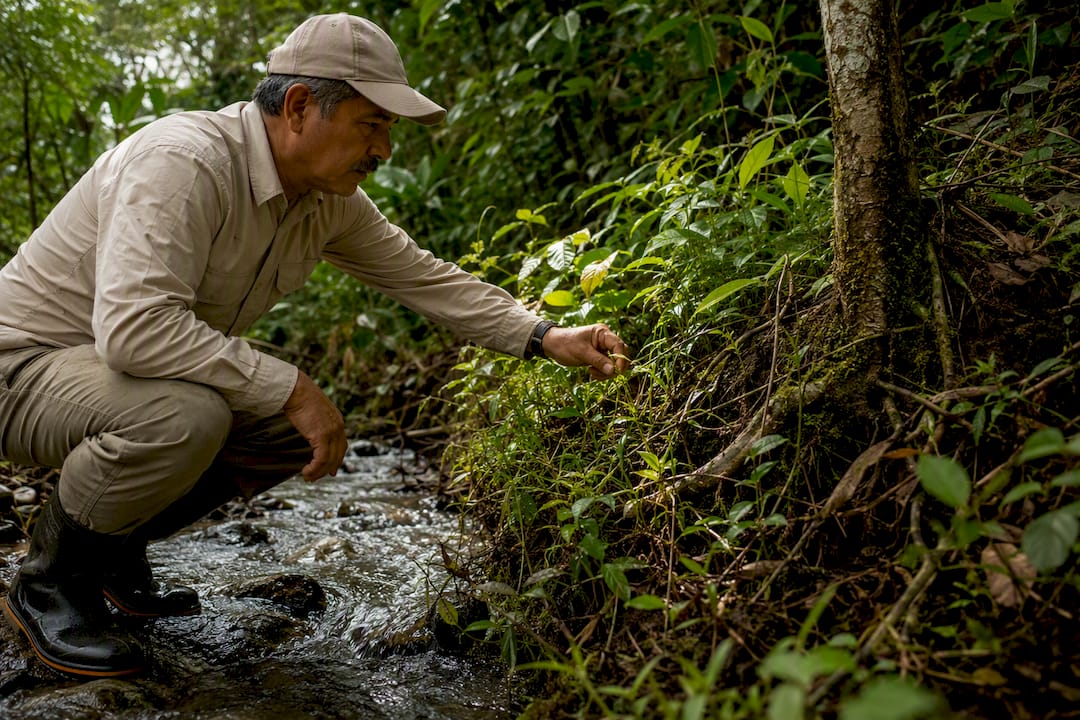
Fairtrade’s environmental requirements exist too, but they’re less central to the brand’s identity than its economic protections. Certified cooperatives must meet baseline environmental criteria, and premium funds are sometimes directed toward environmental projects, like reforestation or water conservation, when cooperative members vote to prioritize them. That’s a meaningful but secondary environmental role compared to Rainforest Alliance’s audit-driven approach.
Biodiversity conservation is where the contrast sharpens most. Rainforest Alliance’s origins as a conservation nonprofit mean its standards were built around forest and habitat protection from day one, and its current criteria on deforestation-free supply chains directly respond to global concerns about agricultural expansion destroying tropical forest cover. That focus matters more than ever as companies face mounting regulatory pressure, including looming EU deforestation rules, to prove their supply chains aren’t linked to forest loss.
For shoppers who weigh climate and biodiversity heavily in a purchase decision, Rainforest Alliance’s audit trail offers more documented specificity than Fairtrade’s broader, cooperative-driven approach.
Labor Rights and Community Benefits Under Each Standard
Both certifications prohibit forced labor and child labor, require fair treatment of workers, and mandate certain wage and safety protections. Where they diverge is in emphasis and mechanism.
Fairtrade ties social benefit directly to its premium system. Because cooperatives vote democratically on premium spending, community benefits often show up as shared infrastructure: schools, clinics, water systems, or scholarship funds. Fair Trade Certified’s own framing centers explicitly on worker well-being and community development as core goals, not side effects. Democratic governance means labor voice is somewhat built into the system by design, since cooperative members elect leadership and vote on fund allocation.
Rainforest Alliance’s labor standards operate more through audited compliance criteria: farms must document wages, working conditions, and grievance systems that auditors check against a checklist. It’s less about collective fund governance and more about verified minimum standards across every certified operation, plantation or smallholder alike. Community benefit under Rainforest Alliance tends to arrive through Sustainability Investments that buyers direct toward specific projects, rather than through a farmer-controlled fund.
Neither model is inherently superior on labor protection. Fairtrade gives producers more direct control over how social benefits get spent; Rainforest Alliance gives buyers and auditors more granular, checklist-style verification of baseline conditions.
Certification Costs Producers Actually Pay
Getting certified isn’t free for farmers, and the fee structures differ in ways that matter for smallholders deciding which path makes financial sense.
Fairtrade certification typically involves an application fee plus recurring audit fees, scaled to cooperative size, alongside the operational cost of maintaining democratic governance structures and premium fund reporting. Because Fairtrade centers on cooperatives rather than individual farms, costs often get spread across many members, which can lower the per-farmer burden compared to an individual certification path.
Rainforest Alliance certification also charges application and annual audit fees, and because its supply-chain certification process covers everything from individual farms to large plantations to the buyers and traders in between, fee structures vary considerably by supply-chain role and volume. Larger operations often absorb these costs more easily than smallholders, which is part of why critics argue the standard can favor bigger producers who can spread certification overhead across greater output.
For smallholders specifically, neither certification is cheap to obtain or maintain, and both typically require ongoing investment in recordkeeping, training, and infrastructure upgrades to pass repeated audits. Buyers who pay Sustainability Investments or Fairtrade premiums sometimes offset a portion of that cost, but the upfront burden of getting certified in the first place still falls largely on the producer or cooperative seeking the seal.
What Actually Matters When You’re Standing in the Coffee Aisle
Most guides treat this comparison like a scorecard with a winner. It isn’t one. The honest read of the research is that Fairtrade and Rainforest Alliance solve adjacent but different problems, and treating either as a universal seal of virtue misses the point of both.
Here’s what the conventional advice gets wrong: it tells shoppers to “look for the label” as if any credible seal guarantees the same thing. It doesn’t. A Rainforest Alliance logo tells you almost nothing about what the farmer was paid above market rate. A Fairtrade logo tells you almost nothing about biodiversity outcomes on that specific farm. Conflating the two is how well-meaning shoppers end up making assumptions the label was never built to support.
What should actually drive your decision is whether you can trace a specific brand’s sourcing claims back to specifics: a named cooperative, a documented price paid, a real traceability code. That’s harder than reading a logo, but it’s the only way to know what you’re actually funding. A brand willing to answer those questions, certified or not, usually deserves more trust than a bag with a seal and nothing else behind it.
— Jenny
A Values-Aligned Option If You Want Both Priorities Covered
We build our sourcing model around direct farmer compensation rather than a market-negotiated differential. Our Catalyst Freshly Roasted Coffee comes from women-owned farms and pays premium compensation tied directly to the growers behind it, roasted in small batches rather than mass-produced at scale.
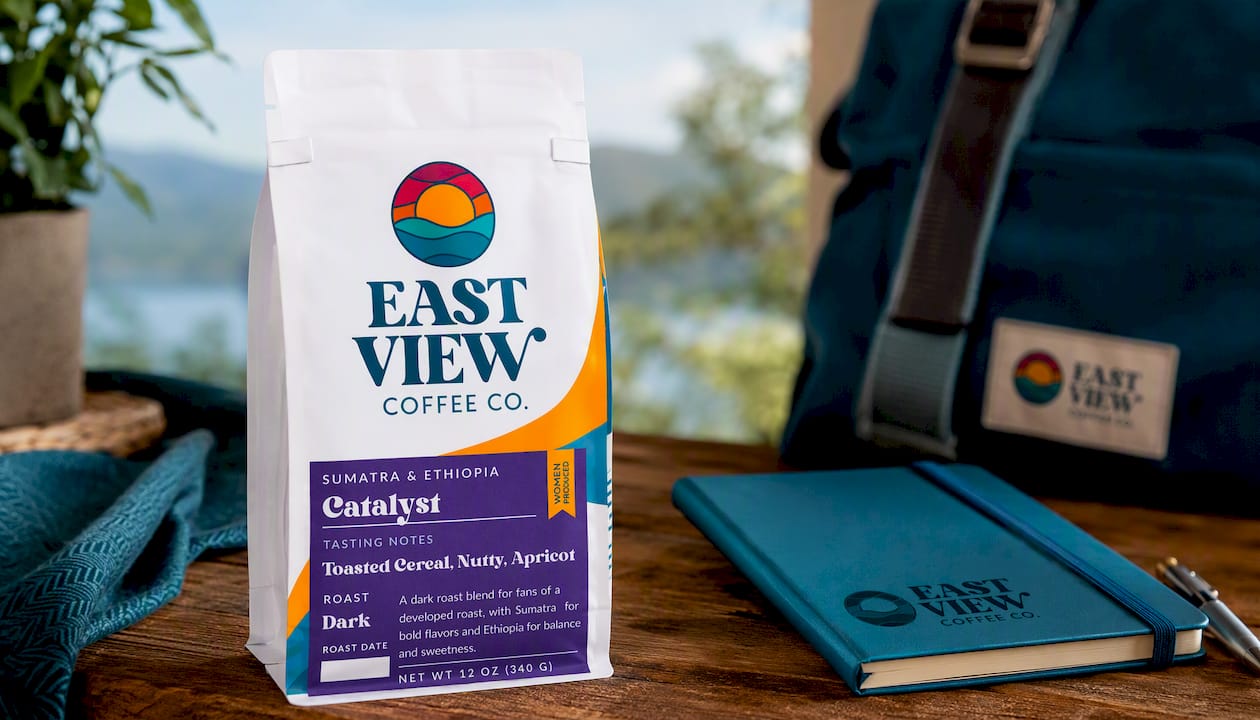
This isn’t a claim to replace certification research. It’s one concrete way to act on it. The Catalyst product page lays out sourcing details so you can judge the compensation model for yourself, the same way this guide encouraged you to judge any brand’s claims. If the farm-to-cup transparency described here matters to your next bag of coffee, that page is where to look at it directly and place an order.
Sources
- What Is the Difference Between Rainforest Alliance and Fairtrade Certification? — Rainforest Alliance
- Tea and Coffee Certification Schemes — Ethical Consumer
- Fair Trade vs. Rainforest Alliance — Fair Trade Certified
FAQ
Is Rainforest Alliance Trustworthy?
Rainforest Alliance’s standards are third-party audited and backed by digital traceability tools like MyRA and RACP, but critics note that its market-negotiated Sustainability Differential makes payment levels harder for consumers to verify than a fixed Fairtrade price floor.
What Is the Main Controversy Around Rainforest Alliance?
The biggest recurring criticism is label confusion: shoppers often assume the Rainforest Alliance seal guarantees the same income protections as Fairtrade, when it actually certifies farm-management and environmental standards instead.
Is Rainforest Alliance Ethical?
Rainforest Alliance certification enforces real labor and environmental audits, including bans on forced and child labor, but it doesn’t guarantee a fixed minimum price the way Fairtrade does, so its ethical weight leans more toward environmental stewardship than direct income protection.
Are There Downsides to Fairtrade Certification?
Yes. Fairtrade’s cooperative structure means benefits arrive as shared community investments rather than identical individual payouts, and farmers outside an organized cooperative can’t access its protections at all.
Can a Coffee Carry Both Certifications?
Yes, and it’s increasingly common. Brands sometimes pursue both Fairtrade and Rainforest Alliance to cover income protection and environmental standards simultaneously, though sourcing models like Eastviewcoffee’s direct farmer relationships offer another route to the same goal.