
Sustainable Coffee Farming: A Practical Guide for Farmers, Buyers, and Conscious Consumers
Sustainable coffee farming means managing land, water, and people in ways that restore soil health, protect biodiversity, and keep farm households economically viable across generations. It goes beyond avoiding harm; the best systems actively rebuild what intensive production has degraded. Here is what that looks like in practice:
- Agroforestry and shade management to cool microclimates and shelter biodiversity
- Soil health practices: composting, cover crops, reduced tillage, and mulching
- Water management: efficient irrigation, watershed protection, and clean pulping
- Integrated pest and disease management using site-specific, low-input methods
- Diversified income streams: food crops, beekeeping, and ecotourism
- Farmer partnerships and cooperatives to pool resources and negotiate better prices
- Measurement and monitoring: soil organic matter, yield logs, and biodiversity counts
- Low-carbon post-harvest processing: solar dryers, efficient roasting, and reduced-water pulping
Certifications like Rainforest Alliance, Fairtrade, and USDA Organic set useful environmental and social baselines, but they do not guarantee that premiums reach farmers or that practices fit local conditions. Buyer programs and direct relationships often fill that gap.
Key Takeaways
Sustainable coffee farming delivers lasting farm resilience only when soil health, biodiversity, water management, and fair economics are addressed together, not in isolation.
| Point | Details |
|---|---|
| Start with low-cost practices | Mulching, cover crops, and shade-tree planting deliver the fastest return before capital investments. |
| Certifications have real limits | Schemes like Rainforest Alliance set baselines but do not guarantee premiums reach farmers; direct relationships fill that gap. |
| Measurement drives credibility | Track soil organic matter, yield stability, and farm-gate price as a percentage of export price to document real progress. |
| Buyer relationships fund transitions | Forward contracts and transparent premium reporting give farmers the financial confidence to invest in long-term improvements. |
| Eastviewcoffee sources differently | Direct buying from women-owned farms with published producer stories and small-batch roasting keeps traceability intact from farm to cup. |
Table of Contents
- Why sustainable coffee farming matters right now
- Core on-farm sustainable coffee farming practices
- Community-level and economic approaches that make sustainability viable
- Certifications, standards, and market models: what they do and where they fall short
- How large buyers and roasters support sustainable farming
- How to measure whether a farm or program is truly sustainable
- Relationship coffee in practice: how women-producer sourcing delivers real farm outcomes
- Does sustainable farming actually pay? The economics at farm level
- A step-by-step roadmap for transitioning to sustainable coffee farming
- Digital tools and technology that support sustainable coffee farming
- The trade-offs nobody talks about when transitioning to sustainable practices
- Support sustainable farms with your next coffee purchase
- Sources
- FAQ
Why sustainable coffee farming matters right now
Coffee is farmed across a large area on millions of farms worldwide, supporting hundreds of millions of people across the supply chain. That scale makes the sector’s environmental footprint enormous and its social stakes equally high.
The climate threat is already measurable. Rising temperatures, shifting rainfall patterns, and the spread of Coffee Leaf Rust (CLR) are reducing suitable growing areas and destabilizing yields in major producing regions. Farms that depend on a single variety in full sun face the sharpest exposure.
Agroforestry and multifunctional coffee systems reduce biodiversity loss and lower fertilizer dependency compared with intensive monocultures, and they buffer farms against temperature extremes. When soil organic matter drops, water retention falls with it, making drought years more damaging. When tree cover disappears, beneficial insects and birds that control pests go with it. The ecological and economic risks compound each other quickly.
Conservation organizations are connecting farmers to incentives that reward conservation outcomes, showing that landscape-level protection and farm-level profitability can reinforce each other rather than trade off.
Core on-farm sustainable coffee farming practices
Regenerative agriculture for coffee focuses on restoring soil, water, and biodiversity to deliver both ecological and economic resilience. The Global Coffee Platform’s RegenCoffee guidance organizes this around three pillars: soil, water, and biodiversity. Here is how each translates to farm-level action.
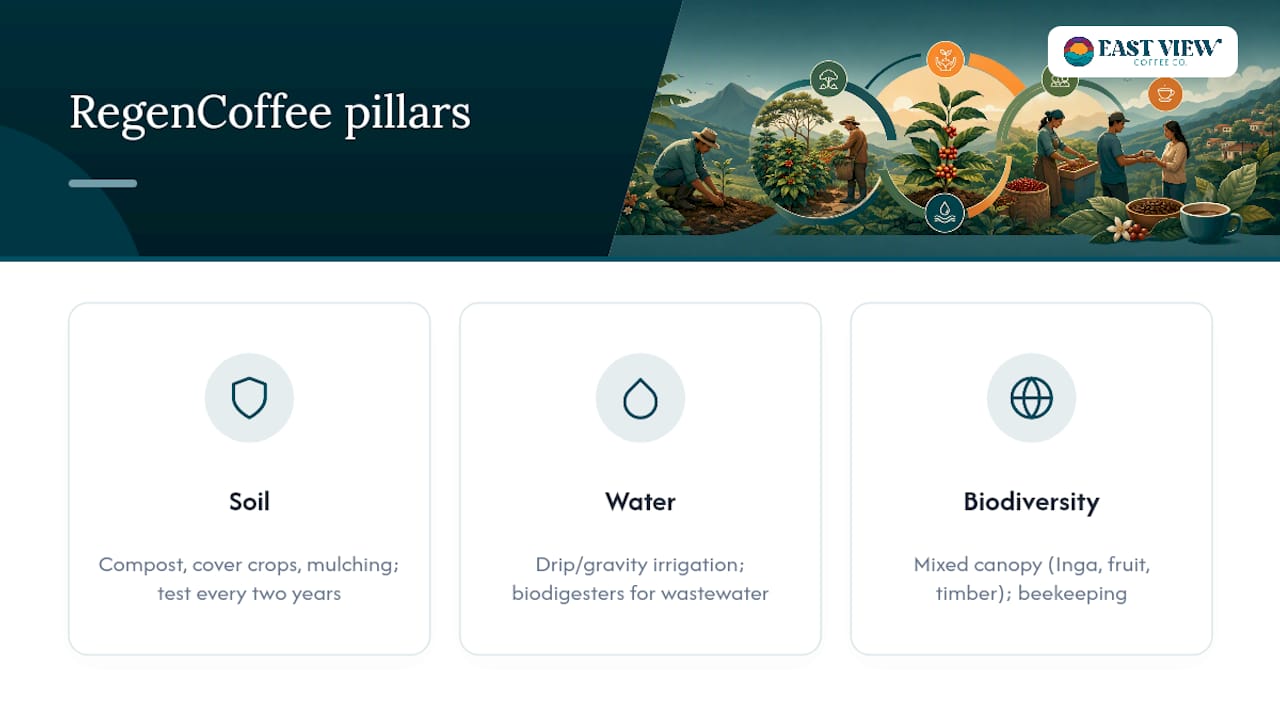
Agroforestry and shade management. Plant a mixed canopy of nitrogen-fixing trees (Inga spp. are widely used in Latin America), fruit trees, and timber species at a density suited to your altitude and rainfall. A well-designed shade system lowers soil temperature by several degrees, reduces evaporation, and creates habitat for birds and beneficial insects. Start with a simple two-layer system before adding complexity.
Soil health. Apply compost or vermicompost at the base of plants after harvest. Use cover crops in alleys between rows to fix nitrogen and suppress weeds. Avoid bare soil on slopes; mulch with pruned material from shade trees. Track progress with a simple soil organic matter test every two years.
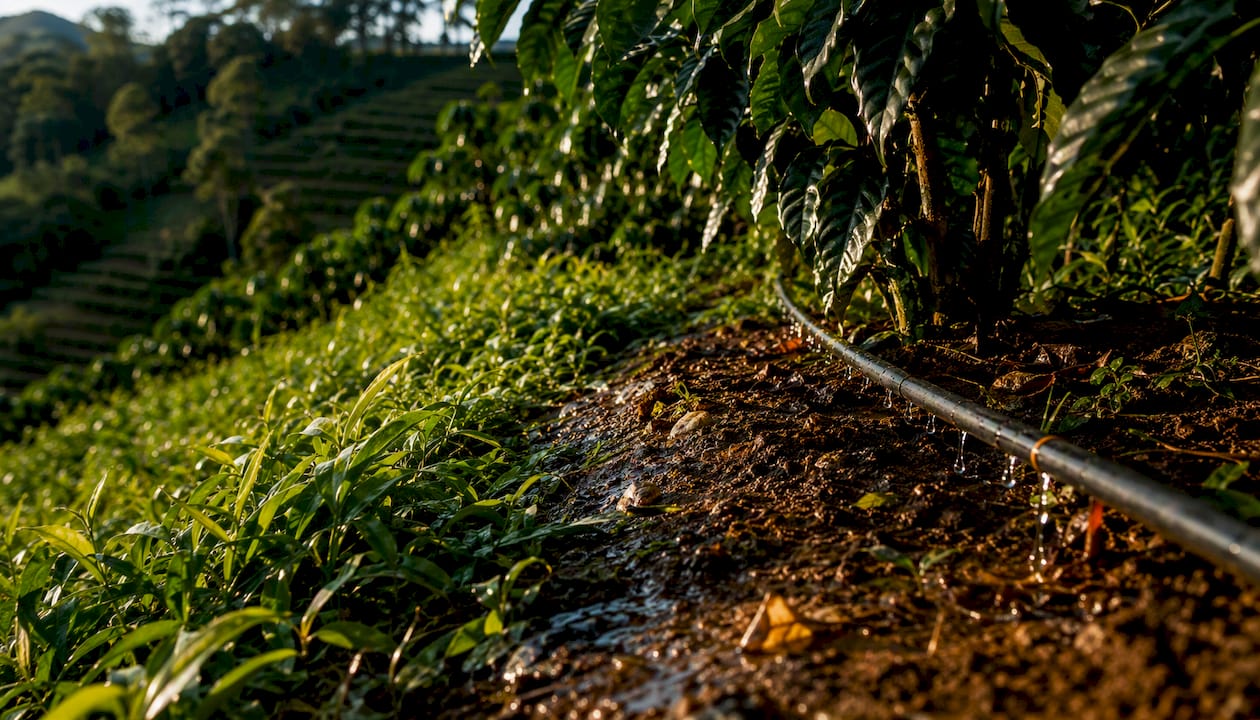
Water management. Drip irrigation or gravity-fed systems cut water use sharply compared with flood irrigation. Pulping wastewater is one of the most damaging outputs from wet processing; closed-loop or biodigester systems prevent it from reaching streams. Contour planting and live barriers slow runoff and recharge groundwater.
Integrated pest and disease management. Smallholders can reduce Coffee Berry Disease and Coffee Leaf Rust pressure through site-specific, low-input interventions such as no-tillage, mulching, and Indigenous Microorganisms (IMOs) without heavy synthetic chemical use. Planting disease-resistant varieties (Catimor, Marsellesa, or newer hybrids) alongside these practices gives the strongest protection.
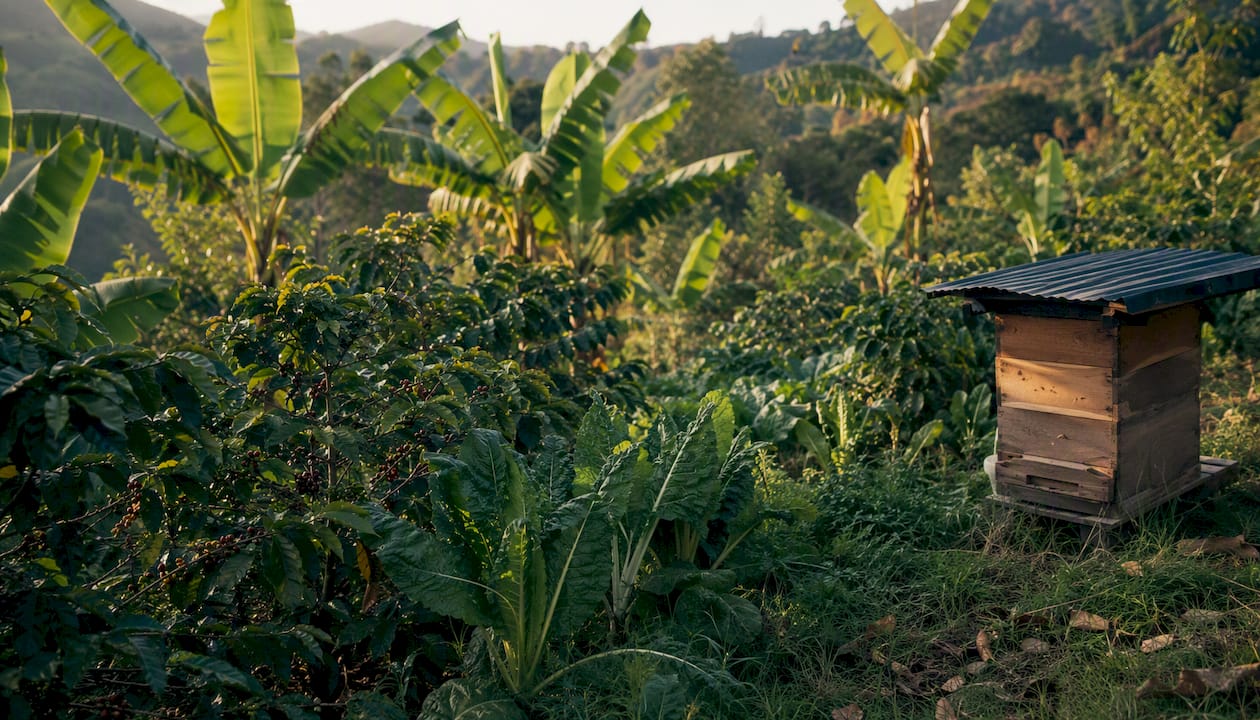
Diversification. Intercropping with plantain, banana, or vegetables provides food security and a cash buffer during low-yield years. Beekeeping adds pollination services and a saleable product. Even small-scale ecotourism can generate income during the transition period when yields may dip.
Practical sequencing. Expect a possible yield dip of one to two seasons when transitioning from high-input monoculture. Prioritize low-cost, high-impact steps first: mulching, cover crops, and shade tree planting require minimal capital. Soil amendments and irrigation upgrades come next. Seek buyer pre-financing or NGO grants before investing in infrastructure.
Pro Tip: Before planting shade trees, map your farm’s sun exposure and prevailing winds. A poorly placed dense canopy can increase humidity and fungal pressure rather than reduce it. Consult your local agricultural extension office or a cooperative agronomist for a site-specific planting plan.
Community-level and economic approaches that make sustainability viable
Individual farm practices only scale when farmers have access to markets, finance, and knowledge. Cooperatives are the most proven vehicle for that access. A cooperative can aggregate volume to meet certification minimums, negotiate collective contracts, share the cost of a cupping lab or processing station, and distribute premiums more transparently than a multi-tier supply chain.
Farmer-led agroecology goes further. When farmers set the priorities, whether that means erosion control, reducing chemical costs, or building water storage, the practices adopted tend to fit local conditions better than a certification checklist written in Geneva or Washington. Producer-led programs often produce more context-appropriate outcomes precisely because local decision-making replaces one-size-fits-all requirements.
Finance is the most common bottleneck for smallholders attempting a transition. Buyer-funded programs that offer pre-financing for inputs, disease-resistant seedlings, or processing equipment remove the upfront cost barrier that stops most farms from changing. Blended finance models, where an NGO or development bank absorbs early-stage risk, are expanding this access in East Africa and Central America.
Gender-focused initiatives matter here too. Women manage a significant share of coffee labor globally but often lack land titles, credit access, or a seat in cooperative governance. Programs that direct training, premium payments, and leadership roles specifically to women producers tend to improve household nutrition, reinvestment rates, and farm outcomes. Conservation International’s work documents how linking conservation incentives to farmer programs can include women producers as primary beneficiaries.
Pro Tip: If you are a buyer or roaster, the most direct way to support farmer finance is a forward contract: commit to purchasing a defined volume at a defined price before harvest. That commitment alone can unlock a farmer’s access to local credit.
Certifications, standards, and market models: what they do and where they fall short
Certifications are not all equivalent, and understanding the differences helps buyers and farmers choose where to invest their energy.
| Scheme | Primary focus | Verification method | Known limits |
|---|---|---|---|
| Rainforest Alliance | Environmental and social baselines | Third-party audit, annual | Premium distribution to farmers is not guaranteed |
| Fairtrade | Minimum price floor and social premium | Cooperative-level audit | Price floor often below market; covers cooperatives, not all farm types |
| USDA Organic | No synthetic inputs | Third-party certification, annual | No direct social or income standard |
| Global Coffee Platform (GCP) | Collective reporting, aligned metrics | Self-reported, aggregated | Voluntary; no binding farm-level outcome requirement |
GCP’s Collective Reporting aggregates company data on sustainable coffee purchases to create comparable metrics, which helps buyers benchmark progress year over year. That transparency is valuable, but collective reporting does not replace on-the-ground verification.
Relationship coffee and direct trade models address the premium-distribution gap most directly. When a roaster buys directly from a cooperative or farm, the price negotiation is visible to both parties, and premiums do not disappear into intermediary margins. The risk is that direct relationships require more sourcing capacity and travel than most small roasters can sustain. A hybrid approach, using certification for baseline assurance and direct relationships for premium sourcing, is the most practical model for most buyers. Local sourcing strategies in food service show the same pattern: proximity and relationship reduce information gaps that certification alone cannot close.
How large buyers and roasters support sustainable farming
Large buyers have the purchasing power to fund programs that individual farmers cannot afford alone. The most effective buyer interventions share a few common elements:
- Farmer support centers: on-the-ground agronomists who visit farms, diagnose problems, and provide tailored advice. Starbucks operates these centers in several producing countries, offering training on soil management, water conservation, and disease response.
- Disease-resistant seedling programs: Nespresso’s AAA Sustainable Quality Program distributes improved seedlings and agronomic training to enrolled farmers, directly addressing CLR vulnerability.
- Long-term purchase agreements: a multi-year contract removes price uncertainty and gives farmers the confidence to invest in shade trees or composting infrastructure that takes years to pay back.
- Transparent premium reporting: publishing the farm-gate price paid, not just the retail price, lets consumers verify that premiums are real.
- Processing and roasting efficiency: smart convection roasting technology can reduce fuel use and emissions while maintaining roast quality while maintaining roast quality. Sustainability does not stop at the farm gate.
Small roasters can replicate the most impactful elements without a global supply chain. A direct relationship with one cooperative, a published farm-gate price, and a commitment to buy a defined volume annually delivers more measurable impact than a certification logo alone. Sustainability practices in food service operations increasingly reflect the same logic: transparency and traceability matter more to buyers than label recognition.
How to measure whether a farm or program is truly sustainable
Measurement does not need to be expensive. A minimum viable monitoring plan for a smallholder farm covers five indicators tracked once or twice per year.
- Soil organic matter (%): a basic lab test or field kit every two years; target a rising trend over time.
- Water infiltration rate: a simple ring infiltrometer test shows whether soil structure is improving.
- Tree and shrub species count: a 15-minute walk-count on a fixed transect; more species means more resilience.
- Yield stability: kilograms of cherry per hectare across three or more consecutive harvests; look for reduced variance, not just higher averages.
- Household income from coffee: track gross revenue and input costs separately to see whether margins are improving.
For buyers and program managers, add:
- Farm-gate price as a percentage of export price: the clearest proxy for whether premiums reach farmers.
- Percentage of farms with shade cover above a defined threshold: a drone or satellite image makes this scalable.
The GCP’s RegenCoffee guidance links these practice-based and outcome-based indicators to specific regenerative objectives, giving programs a structured framework to report against.
Simple photopoints, taken from the same spot each season, document canopy change visually without any equipment. Yield logs kept in a notebook are enough to spot trends. Lab testing and third-party verification add credibility when seeking certification or buyer premiums, but they are not the starting point.
Relationship coffee in practice: how women-producer sourcing delivers real farm outcomes
The gap between a certification label and a measurable farm improvement is where relationship-based sourcing earns its credibility. Eastviewcoffee sources exclusively from women-owned farms, paying premiums that go directly to the producers, not through opaque intermediary chains.
- Direct buying means the farm-gate price is negotiated transparently, and Eastviewcoffee can verify that the premium reaches the producer.
- Small-batch roasting in Kenosha, Wisconsin preserves the traceability from farm to cup; each lot is roasted to order rather than blended into anonymity.
- Storytelling and producer profiles give consumers a direct connection to the farm, which sustains demand for that specific origin across seasons.
- The Café con Amor direct-relationship coffee from Costa Rica is a concrete example: a named origin, a named relationship, and a price structure that reflects the cost of sustainable production.
The most underused tool in ethical sourcing is the producer story. When a consumer knows the name of the farm and the woman who runs it, they are far less likely to trade down on price. That loyalty is what funds the next season’s seedlings, the next training visit, and the next year of shade-tree maintenance.
Other roasters can replicate this model. Publish the farm-gate price. Name the producer. Commit to a multi-season relationship before the first bag ships. Eastviewcoffee’s women-producer collection shows what that transparency looks like in a retail context.
Does sustainable farming actually pay? The economics at farm level
The honest answer is: it depends on the timeline and the starting point. In the first one to two seasons after transitioning from high-input monoculture, input costs may fall but yields can dip as soil biology rebuilds. Farmers who enter the transition with debt or thin margins face real risk during that window.
Over a three-to-five-year horizon, the economics shift. Reduced synthetic input costs, improved soil water retention (which cuts irrigation needs), and access to premium markets through certification or direct trade all improve margins. Shade-grown and organic coffees consistently attract price premiums in specialty markets. Diversified income from intercropped food or timber reduces the volatility of a single-commodity income.
The key cost-benefit insight: low-cost practices like mulching, cover crops, and shade-tree planting from on-farm material deliver the fastest return on investment. Capital-intensive upgrades like drip irrigation or biodigesters require external financing and a longer payback period. Sequencing matters as much as the practice list itself.
A step-by-step roadmap for transitioning to sustainable coffee farming
Year 1: Baseline and low-cost actions. Map your farm’s current state: soil type, shade cover, water sources, and pest pressure. Start mulching immediately using pruned material. Plant cover crops in alleys. Identify two or three shade tree species suited to your altitude and begin nursery propagation.
Year 2: Soil and water investments. Apply compost or vermicompost. Install contour barriers or live hedges on slopes. If you use wet processing, assess your wastewater management and identify a low-cost improvement (a settling pond, a biodigester, or a switch to dry processing for part of your crop).
Year 3: Diversification and market access. Intercrop food or cash crops between rows. Join or form a farmer group to pool certification costs and negotiate collectively. Approach buyers with your monitoring data; documented soil and yield trends are a stronger negotiating tool than a certification alone.
Year 4 and beyond: Certification and premium markets. Once practices are established and documented, certification becomes a credible signal rather than a compliance exercise. Pursue Rainforest Alliance, Organic, or Fairtrade based on which premium market your buyer serves. Continue monitoring and adjust practices based on what the data shows.
Digital tools and technology that support sustainable coffee farming
Technology is closing the information gap that has historically disadvantaged smallholders. A few tools are genuinely useful at farm scale.
Mobile farm management apps like Farmerline and iCow allow farmers to log inputs, yields, and weather events on a basic smartphone. That data builds the yield history needed to demonstrate sustainability progress to buyers and certifiers.
Remote sensing and satellite imagery through platforms like Google Earth Engine or Satelligence let buyers and program managers monitor shade cover, deforestation risk, and land-use change across entire supply sheds without farm visits. Some certification bodies are beginning to use satellite verification as a supplement to audits.
Soil sensor networks are still expensive for individual smallholders but are increasingly available through cooperative-level programs. A shared sensor at a cooperative processing station can monitor soil moisture and temperature across member farms.
Weather and climate advisory services like CGIAR’s climate-smart agriculture tools provide localized forecasts and agronomic recommendations, helping farmers time planting, irrigation, and pest management more precisely.
Smart roasting technology on the processing side shows that digital precision matters beyond the farm gate too. Convection roasting systems with real-time monitoring reduce fuel use and improve consistency, which matters for roasters trying to reduce their emissions footprint.
The trade-offs nobody talks about when transitioning to sustainable practices
Most articles on sustainable coffee farming present the transition as a straightforward upgrade. The reality is messier, and pretending otherwise sets farmers up for frustration.
The yield dip in years one and two is real. Soil biology takes time to rebuild after years of synthetic fertilizer dependence. Farmers who expect immediate yield gains will be disappointed and may abandon the transition before the benefits materialize. Honest buyer communication about this timeline is part of what makes a relationship-based model more ethical than a certification-only approach.
Certification costs are not trivial for smallholders. Annual audits, documentation requirements, and the time spent on compliance all have real costs. For farms below a certain scale, the premium earned rarely covers the certification overhead without cooperative pooling.
The practices that deliver the most long-term value, agroforestry and soil rebuilding, also require the most patience. A shade tree planted today takes three to five years to provide meaningful canopy. That is a hard sell to a farmer facing immediate cash pressure. The decision framework that works: start with what costs nothing (mulching, cover crops, photopoints), layer in what costs little (compost, contour barriers), and defer capital investments until a buyer relationship or grant funding is in place.
Support sustainable farms with your next coffee purchase
Every bag of coffee you buy is a vote for a farming system. Eastviewcoffee makes that vote count by sourcing exclusively from women-owned farms, paying premiums that go directly to producers, and roasting in small batches in Kenosha, Wisconsin so every lot stays traceable.
Before you buy from any roaster, run this three-item check: Does the roaster publish the farm-gate price or a named producer? Is there a documented premium above commodity price? Can you find the farmer’s story, not just a country of origin? Eastviewcoffee passes all three. Browse the women-producer collection or explore seasonal single-origin coffees sourced from farms where sustainability is measured, not just marketed. Not sure where to start? Get a custom coffee recommendation matched to your taste and values.
Sources
- GCP-RegenCoffee-Guidance-2025.pdf
- Sustainable coffee: A review of the diverse initiatives and governance dimensions of global coffee supply chains
- The Planetary Health Impacts of Coffee Farming Systems in Latin America: A Review
- Frontiers in Sustainable Food Systems article (2025)
- As coffee demand grows, farmers work to deliver a sustainable brew
FAQ
What is sustainable coffee farming in simple terms?
Sustainable coffee farming manages land, water, and farm households in ways that restore soil health, protect biodiversity, and keep farmers economically viable across generations. It combines on-farm practices like agroforestry and composting with fair market relationships.
Which certifications are most meaningful for sustainable coffee?
Rainforest Alliance, Fairtrade, and USDA Organic each address different priorities: environmental baselines, minimum price floors, and no synthetic inputs, respectively. None guarantees that premiums reach individual farmers, so direct-trade relationships are a valuable complement.
How long does it take to see results from sustainable farming practices?
Low-cost practices like mulching and cover crops show soil and yield benefits within one to two seasons. Agroforestry and soil rebuilding take three to five years to deliver full canopy and measurable organic matter gains.
How can consumers support sustainable coffee farming?
Buy from roasters who publish farm-gate prices, name their producers, and document premiums paid above commodity price. Subscriptions and direct-relationship coffees, like those from Eastviewcoffee’s women-producer collection, provide farmers with predictable income across seasons.
What role do cooperatives play in sustainable coffee production?
Cooperatives pool volume to meet certification minimums, share the cost of processing infrastructure, and negotiate collectively for better prices. They are the most proven vehicle for scaling sustainable practices among smallholders who lack individual market access.