
Cut Caffeine 30–60% and Still Enjoy Coffee If You're Sensitive
If you want the stimulant effect to disappear almost entirely, pick a quality decaf. If you still want a small lift, go with a half-caff or a naturally low-caffeine varietal and pair it with the brewing tweaks below. Either path lets you keep the ritual: the FDA’s safety guidance and clinical tapering advice recommend a gradual reduction rather than quitting cold. Decaf and half-caff roasts are available, so the switch doesn’t mean switching brands.
TL;DR:
- Drinking decaf can reduce caffeine intake to about 2 to 15 mg per 8 oz cup, which helps evening consumption and sensitivity management.
- Brewing with coarser grind, shorter contact time, and lower temperature can decrease caffeine extraction by up to 60 percent without needing new equipment.
- Mixing decaf and regular beans at a 50/50 ratio and grinding decaf beans slightly coarser ensures a balanced flavor in half-caff blends.
- Adding hot water does not lower caffeine content but only dilutes concentration; adjusting brew variables is necessary for meaningful caffeine reduction.
- Tapering caffeine intake gradually over weeks, rather than quitting abruptly, minimizes withdrawal symptoms and helps maintain a coffee routine.
Table of Contents
- Decaf, Half-Caff, or Low-Caffeine Varietal: What Each One Actually Gives You
- How Do You Brew Coffee With Less Caffeine?
- How Do You Make a Half-Caff That Doesn’t Taste Watered Down?
- Fixing the Most Common Low-Caffeine Coffee Mistakes
- When Should You Drink Coffee If You’re Caffeine Sensitive?
- What Can You Drink Instead When You Want a Break From Caffeine
- What Actually Works to Manage Caffeine Sensitivity While Still Drinking Coffee
- Symptoms and Health Considerations Worth Knowing
- Jenny’s Note on Building Decaf and Half-Caff That Don’t Taste Like an Afterthought
- Where to Find Low-Caffeine Options That Still Taste Like Real Coffee
- Sources
- FAQ
Decaf, Half-Caff, or Low-Caffeine Varietal: What Each One Actually Gives You
The three product paths solve slightly different problems. Picking the wrong one is the most common mistake people make when they first try to cut back.
Decaf typically lands around 2 to 15 mg of caffeine per 8 oz cup, according to the FDA. That’s roughly 97% less than a standard brewed cup. It’s the right call for evening drinking, for anyone with a diagnosed sensitivity, or for someone tapering off caffeine entirely under a clinician’s guidance.
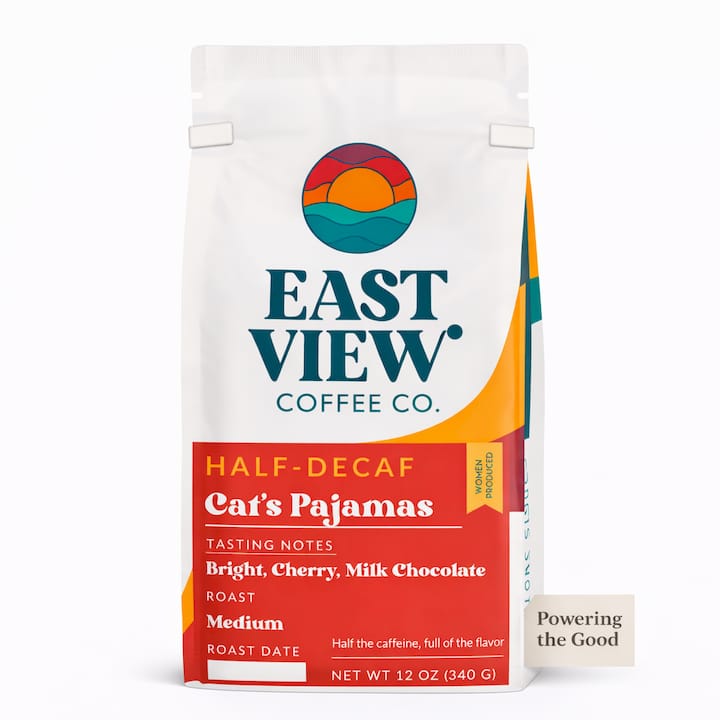
Half-caff generally contains a moderate caffeine amount per 8 oz serving, approximately half of a standard cup. It’s a genuine middle ground: enough lift to feel like coffee, low enough that a 2 PM cup won’t wreck your sleep. East View’s Cat’s Pajamas Half-Caff is built exactly for this niche, blending regular and decaffeinated beans so you get body and flavor without the full jolt.
Naturally low-caffeine varietals, like some laurina cultivars, exist but are rare and inconsistent at the retail level. Most specialty roasters don’t stock them regularly, which makes decaf and half-caff far more practical everyday options.
One detail that matters more than people realize: how the beans were decaffeinated.
- Swiss Water Process uses only water and carbon filtration, no chemical solvents, and tends to preserve flavor well.
- CO2 processing uses pressurized carbon dioxide and is common in larger-scale decaf production.
- Sugarcane EA (ethyl acetate) uses a naturally derived solvent from fermented sugarcane, a middle-ground method many specialty roasters favor.
Check the bag. If the roaster doesn’t disclose the decaf method, that’s a transparency gap worth noticing.
How Do You Brew Coffee With Less Caffeine?
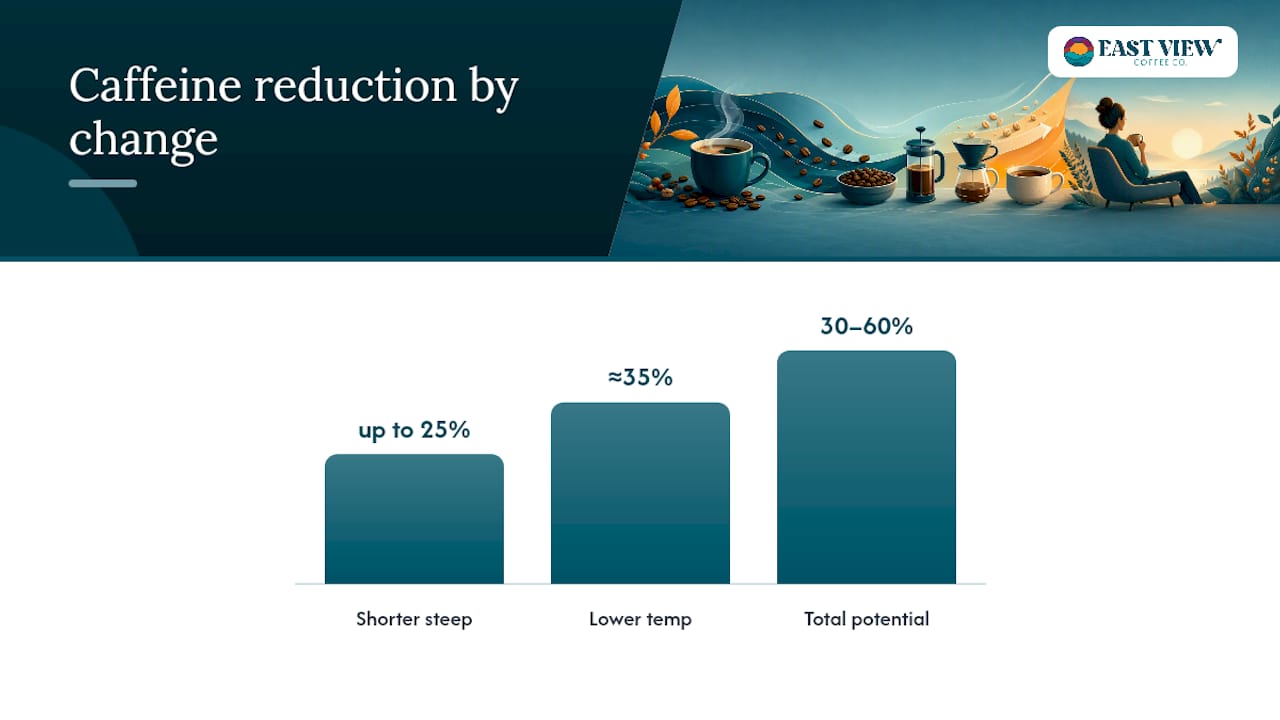
Brewing adjustments can cut caffeine extraction by roughly 30 to 60%, depending on which variables you change and how far you push them. This matters even more once you understand that roast level alone doesn’t reliably predict caffeine content. Extraction variables usually do more work than roast degree, according to a 2024 peer-reviewed study on roast degree, extraction yield, and caffeine.
Here’s the priority order, ranked by impact:
- Go coarser. A coarser grind slows extraction across the board and is the single easiest change to make without buying new equipment.
- Shorten contact time. For a French press, cut your steep from the usual 4 minutes down to 2 to 3 minutes. That alone can trim caffeine by up to 25% while keeping most of the body.
- Lower the brew temperature. Extraction rates drop by roughly 35% at 80°C compared to 92°C. Aim for 85 to 90°C instead of boiling water straight off the kettle.
- Reduce your coffee dose slightly. Less coffee grounds means less total caffeine in the pot, independent of concentration.
- Try cold brew. Despite the long steep time, cold brew’s low-temperature diffusion often produces less caffeine per 8 oz than a hot brew, though recipe and ratio still swing the number a lot.
A word on dilution: adding hot water to an espresso shot (an Americano) changes concentration, not total caffeine. You’re drinking the same milligrams in more liquid. If your goal is less caffeine, control extraction and dose, not water volume.
If you go the cold brew route, don’t steep longer than 24 hours refrigerated. Past that window you’re not gaining flavor, just risking spoilage, per food-safety guidance summarized in caffeine content research across brew methods. East View’s brewing guide has starting ratios if you want a baseline before you start adjusting variables.
Pro Tip: Change one variable at a time. If you drop the grind, temperature, and steep time all in the same brew, you’ll get a different cup, but you won’t know which change actually mattered.
How Do You Make a Half-Caff That Doesn’t Taste Watered Down?
Bad half-caff tastes thin because most people treat it like a simple 50/50 split and stop thinking about it. Decaf beans are more porous than regular beans, a side effect of the decaffeination process itself, and porous beans extract faster. If you grind a decaf/regular blend at one uniform setting, the decaf portion over-extracts while the regular portion under-extracts, and you get a muddled, slightly hollow cup.
The fix: grind the decaf component a notch coarser than you normally would, or blend whole beans first and grind the combined mix slightly coarser overall than your usual regular-coffee setting.
If you’re buying rather than blending, look for a few signals on the bag:
- The decaf method is listed by name (Swiss Water, CO2, sugarcane EA), not just “decaffeinated.”
- A visible roast date, ideally within the past two to three weeks.
- Origin transparency for both the decaf and regular components in the blend.
- Small-batch language that suggests the roaster is actually paying attention to the blend ratio, not just mixing bins.
For a home recipe, start at 50/50 by weight, a medium-coarse grind, and a standard 1:16 coffee-to-water ratio. Brew time depends on method, but if you’re using a pour-over, start around 3 minutes and adjust from there.
Buy smaller bags and turn through them faster. Decaf and half-caff blends stale at the same rate as regular coffee, and freshness is doing at least half the flavor work in any lower-caffeine cup.
Fixing the Most Common Low-Caffeine Coffee Mistakes
Cutting caffeine changes your cup’s chemistry, and most complaints trace back to one of three fixable issues.
Sour or thin? You’ve probably under-extracted. Increase your dose slightly, or extend contact time by 15 to 30 seconds, while keeping the grind on the coarser side you settled on earlier.
Watery or weak, especially with decaf? Try a slightly finer grind, switch to a paper filter if you’re using metal, or add a touch more coffee to the basket. Paper filters also trap more oils and compounds than metal, which can help decaf feel less flat.
Bitter or harsh? You’re over-extracting. Drop your water temperature toward 85°C, shorten contact time, and skip the ultra-fine grind settings that work for espresso but punish drip or immersion brews.
Pro Tip: Test one variable per brew and write down what changed. Three cups of trial and error beats guessing your way through an entire bag.
When Should You Drink Coffee If You’re Caffeine Sensitive?
Timing changes how much caffeine actually bothers you, independent of how much you drink. Caffeine has a half-life of several hours, so a cup at 3 PM is still partly active in your system at bedtime. Cutting off caffeinated coffee five to six hours before you plan to sleep gives your body enough runway to clear most of it, according to research on coffee timing and cortisol.
Morning timing matters too, just for a different reason. Cortisol, your body’s natural alertness hormone, peaks shortly after waking. Coffee first thing tends to compete with a system that’s already ramping up on its own, which is part of why some people feel jittery on an empty-stomach morning cup. A mid-morning window, once that initial cortisol spike has settled, is often gentler on a sensitive system.
If you’re sensitive enough that even one cup causes symptoms, front-load your full-caffeine coffee (if you drink any at all) to that mid-morning slot, and shift everything after lunch to decaf or half-caff. You keep the ritual at every part of the day; you just change what’s in the cup as the day goes on.
This is also where half-caff earns its keep. A single afternoon half-caff gives you the coffee break without asking your evening to pay for it. Save straight decaf for anything after dinner, when even a small stimulant dose can interfere with sleep onset for a caffeine-sensitive person.
What Can You Drink Instead When You Want a Break From Caffeine
Some days you want the ritual of a warm cup in your hands without touching caffeine at all, even the small amount in decaf. A few options fit into a coffee routine without breaking it.
Herbal tisanes like rooibos or chamomile work well in the evening slot decaf usually fills, though they don’t replicate coffee’s roasted flavor.
Roasted chicory root brewed like coffee gets closest to that dark, bitter profile, and it’s naturally caffeine-free rather than processed to remove caffeine.
Golden milk or turmeric lattes give you a warm, ritualized drink with a completely different flavor profile, useful for variety rather than substitution.
Decaf cold brew deserves its own mention here. East View’s Cold Brew Blend approach, made with a decaf bean, gives you the low-acid, smooth profile of cold brew with next to no caffeine at all. It’s a good option for anyone who associates “coffee” specifically with the cold brew format rather than drip or espresso.
None of these need to replace coffee outright. Most caffeine-sensitive drinkers do best rotating: decaf or half-caff in the morning, an herbal option in the afternoon, and full skip after dinner. The goal isn’t eliminating coffee. It’s building a day where caffeine load matches your tolerance instead of ignoring it.
What Actually Works to Manage Caffeine Sensitivity While Still Drinking Coffee
The single most effective strategy is also the least dramatic: taper rather than quit. Cutting caffeine abruptly is what triggers the headaches, fatigue, and irritability people associate with caffeine withdrawal. Clinical guidance recommends reducing total intake by roughly 25% per week rather than dropping from three cups to zero overnight.
In practice, that means swapping one regular cup for half-caff this week, another next week, and moving toward decaf as your default over three to four weeks. Withdrawal symptoms are well documented in clinical literature, and they’re avoidable with this kind of gradual approach.
Beyond tapering, a few other levers help:
- Pair coffee with food. Caffeine on an empty stomach hits harder and faster for most sensitive drinkers.
- Track your actual triggers. Some people react to caffeine specifically; others react to acidity or high extraction levels that happen to correlate with strong coffee. Brewing tweaks help the second group even without cutting caffeine.
- Keep total daily volume in mind, not just per-cup strength. Four small decaf cups plus one half-caff can still add up if you’re not tracking it.
None of this requires giving up coffee. It requires treating caffeine load as something you can dial in gradually.
Symptoms and Health Considerations Worth Knowing
Caffeine sensitivity shows up differently from person to person, but the common list includes jitteriness, a racing heart, trouble falling asleep, anxiety spikes, and in some people, stomach upset or acid reflux. None of these require a formal diagnosis to take seriously. If coffee reliably produces two or more of these within an hour of drinking it, your system is telling you something worth adjusting for.
The FDA’s consumer guidance treats moderate caffeine intake as generally safe for most healthy adults, while noting that individual tolerance varies widely and some groups, including pregnant people and those with certain heart conditions, should keep intake lower or check with a doctor. That variability is exactly why a blanket “just drink less coffee” recommendation misses the point. Two people drinking the same cup can have completely different experiences.
Sleep disruption deserves particular attention because it’s often invisible. You might not connect a 2 PM coffee to trouble falling asleep at 11 PM, but caffeine’s multi-hour half-life makes that connection real for a lot of sensitive drinkers. If you’re waking up tired despite going to bed on time, your afternoon coffee habit is worth auditing before you blame anything else.
Withdrawal symptoms, ironically, can feel a lot like sensitivity symptoms: headache, fatigue, irritability. That overlap is exactly why the tapering approach works better than an abrupt switch to decaf. You avoid trading one set of symptoms for another during the transition.
Jenny’s Note on Building Decaf and Half-Caff That Don’t Taste Like an Afterthought
Most decaf gets treated like a compromise, roasted last, sourced last, an afterthought on the shelf. We built our decaf and half-caff lines the opposite way. Sourcing from women-owned farms and roasting in small batches in Kenosha means we can pay the same attention to a decaf lot that we’d give any single-origin.
Cat’s Pajamas Half-Caff exists because “just drink less” isn’t real advice. It’s a blend built to taste balanced, not diluted. Nocturne Decaf gets the same roast-day care as our full-caffeine coffee, because flavor shouldn’t be the thing you sacrifice for a lower stimulant load.
— Jenny
Where to Find Low-Caffeine Options That Still Taste Like Real Coffee
Cutting caffeine shouldn’t mean settling for a flat, forgettable cup, and it doesn’t have to. Roasters who apply the same standards for full-caffeine, half-caff, or decaf batches help ensure consistent quality for switching options.
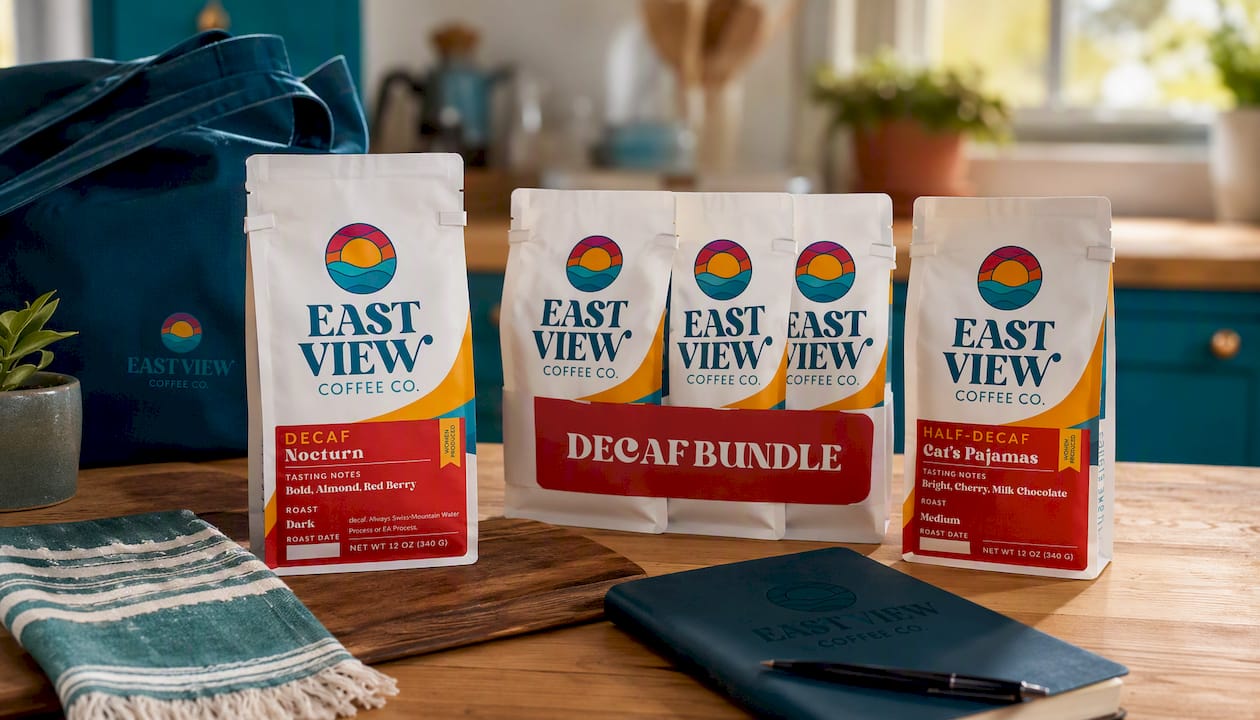
If you want near-zero stimulant effect, start with Nocturne Decaf. It’s roasted specifically for drinkers who want the ritual without the jolt, evening cup or morning cup, doesn’t matter. Want to sample a few decaf roasts before committing to one? The Decaf Coffee Bundle gives you that range in one order. And if you still want some lift, just less of it, Cat’s Pajamas Half-Caff is built as a genuine middle ground rather than a diluted regular roast.
Because freshness matters more with lower-caffeine coffee, not less, consider the Coffee Subscription to keep smaller bags cycling through before they stale. Browse the full decaf collection and place an order today. Your next bag can arrive roasted to order, not sitting on a shelf.
Sources
The brewing and sensitivity guidance here draws on a handful of primary sources rather than general assumptions:
- How to quit caffeine — Cleveland Clinic
- Caffeine withdrawal — NCBI Bookshelf (2023)
- Roast degree, extraction yield, and caffeine — 2024 peer-reviewed study (PMC)
FAQ
Is decaf coffee completely caffeine-free?
No. Decaf typically contains about 2 to 15 mg of caffeine per 8 oz cup, roughly 97% less than a standard brewed cup but not zero.
How much can brewing adjustments actually reduce caffeine?
Combining a coarser grind, shorter contact time, and lower water temperature can cut caffeine extraction by roughly 30 to 60%, depending on how many variables you change and how far you push each one.
Can I mix decaf and regular coffee myself?
Yes, and a 50/50 blend by weight is a solid starting point. Grind the decaf portion slightly coarser than the regular portion, since decaf beans are more porous and extract faster.
Does diluting coffee with water lower the caffeine?
No. Adding water changes concentration per ounce, not the total caffeine extracted from the grounds. Reducing caffeine requires changing extraction variables or dose, not adding hot water afterward.
What’s the difference between decaf and half-caff from East View?
Nocturne Decaf targets near-zero caffeine for evening or high-sensitivity drinkers, while Cat’s Pajamas Half-Caff generally contains about half the caffeine of a standard cup for a moderate lift without the full jolt of a regular cup.