
Low Caffeine Coffee: Varieties, Blends, and Brewing Tips
The easiest way to drink coffee with less caffeine is to pick one of three routes: naturally low-caffeine varieties, half-caff blends, or decaffeinated and low-dose brewing. Each path suits a different goal.
- Naturally low-caffeine varieties (Laurina/Bourbon Pointu, Coffea eugenioides, Coffea racemosa): best for flavor-curious drinkers willing to pay more for a rare, botanically distinct cup. These beans contain roughly 0.2–0.8% caffeine by dry weight versus 1.4–1.6% for standard Arabica.
- Half-caff blends: the practical everyday choice. Mix equal parts caffeinated and decaf beans and you cut caffeine by roughly half without changing your routine. Eastviewcoffee’s Half-A$$ed Half-Caff is a ready-made example.
- Decaffeinated or low-dose brewing: the closest to zero caffeine. Decaf retains a small residual amount, and adjusting your dose or brew method can shave another 20–30% off a standard cup.
Best starter: half-caff or a reduced-dose brew. Curious about something genuinely different? Try Laurina.
Key Takeaways
Naturally low-caffeine varieties, half-caff blends, and decaf each reduce caffeine differently, and dose plus brew method matter more than roast level for any given cup.
| Point | Details |
|---|---|
| Species sets the ceiling | Arabica averages 80–120 mg per 8-oz cup; Robusta runs 150–200 mg; choosing Arabica roughly halves exposure. |
| Dose beats roast | Dropping from 20g to 14g per 12-oz cup reduces caffeine more than switching from light to dark roast. |
| Half-caff is the easiest daily fix | A 50/50 blend of caffeinated and decaf beans cuts caffeine by roughly half with no change to your routine. |
| Naturally low-caff varieties are rare | Laurina, eugenioides, and racemosa contain 0.2–0.8% caffeine by dry weight versus 1.4–1.6% for standard Arabica, but supply is limited and prices are higher. |
| Eastviewcoffee for everyday reduction | Eastviewcoffee’s decaf and Half-A$$ed Half-Caff offer flavor-tested, ethically sourced options for consistent daily caffeine reduction. |
Table of Contents
- What actually controls caffeine in your cup?
- Arabica vs. Robusta: what the caffeine difference means for you
- Naturally low-caffeine coffee varieties: what they taste like and where to find them
- How decaf and half-caff work, and what you give up
- Roast level and serving size: the myths worth correcting
- How to brew for less caffeine without wrecking the flavor
- How to shop for coffee with less caffeine
- What quality low-caffeine coffee looks like: Eastviewcoffee as an example
- The case for starting with what you can actually buy
- Eastviewcoffee’s decaf and half-caff are worth trying
- Sources
What actually controls caffeine in your cup?
Five levers determine how much caffeine ends up in your mug, and they are not all equal.
Species and variety genetics is the biggest one. The plant itself sets the ceiling. Standard Arabica runs roughly 1.4–1.6% caffeine by dry bean weight; Robusta runs with notably higher caffeine content, according to commonly referenced coffee research. Rare varieties like Laurina sit well below Arabica’s floor. No amount of brewing adjustment overcomes a high-caffeine bean.
Post-harvest decaffeination is the most dramatic intervention available after harvest. Done well, it strips out 97% or more of the caffeine while leaving the bean structurally intact. The flavor hit depends on the method, covered in detail below.
Roast level has a smaller effect than most people expect. Darker roasts lose bean mass through moisture and CO2 release, which slightly concentrates caffeine by weight, but the practical difference between a light and dark roast in your cup is minor compared with species or dose.
Grind size and extraction time work together. A coarser grind and a shorter brew pull less caffeine from the same beans. Caffeine is highly soluble, so it extracts early in the brew cycle. A 30-second shorter steep can meaningfully reduce what ends up in the cup.
Serving size and brew ratio is the lever most people ignore. According to FDA-style estimates, an 8-oz brewed cup averages 80–100 mg of caffeine, but a 16-oz pour from the same batch doubles that. Cutting your serving size from 16 oz to 8 oz does more than switching roast levels.
A quick example: two 12-oz cups brewed from the same Arabica beans purchased as Pulneys whole beans dark roast and fruity notes show how roast and dose affect caffeine. One uses 20 grams of coffee with a 4-minute steep; the other uses 14 grams with a 2.5-minute steep. The second cup can deliver noticeably less caffeine from identical beans, purely through dose and time.
Arabica vs. Robusta: what the caffeine difference means for you
The species gap is real and practically useful.
| Coffee type | Typical caffeine per 8-oz serving |
|---|---|
| Robusta-based brewed coffee | 150–200 mg |
| Arabica brewed coffee | 80–120 mg |
| Single-shot espresso (1 oz) | 60–75 mg |
| Instant coffee | 30–90 mg |
| Decaf brewed coffee | 2–15 mg |
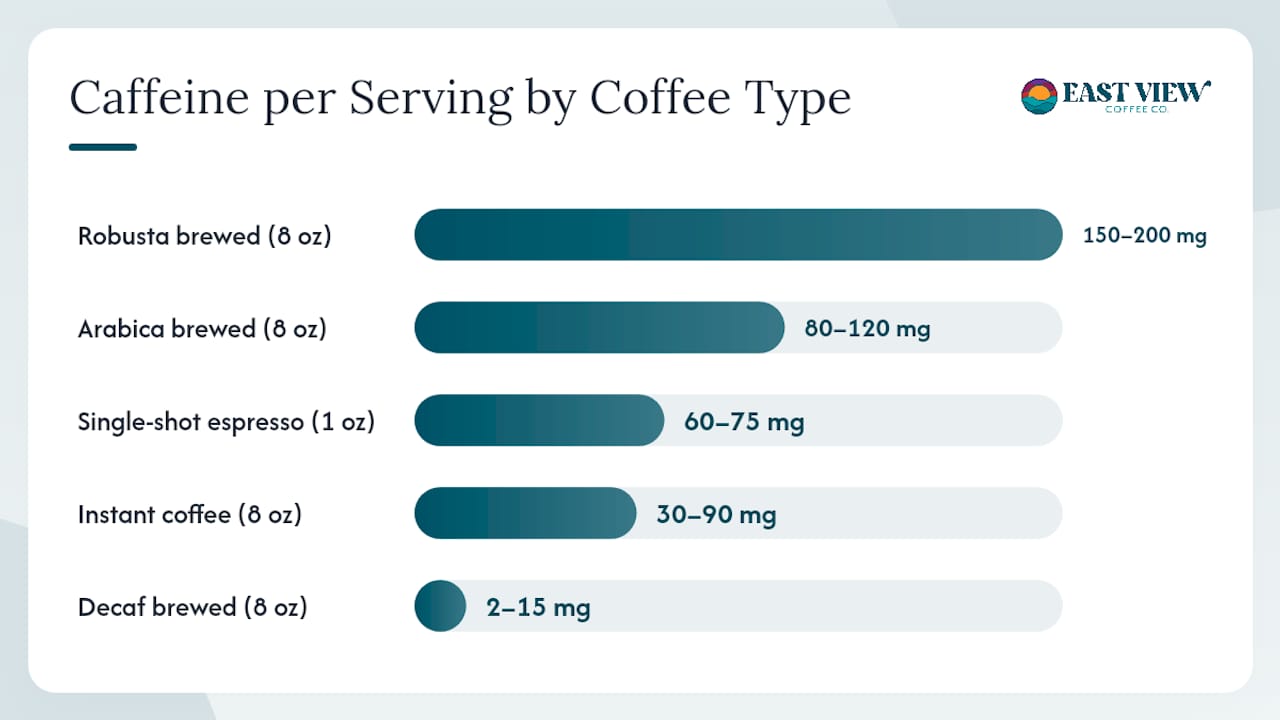
Ranges adapted from FDA-style estimates and peer-reviewed literature.
Choosing Arabica over Robusta roughly halves your caffeine exposure, all else equal. Most specialty coffee sold in the U.S. is already Arabica, so if you are buying from a quality roaster, you are likely already on the lower end of the species range. The bigger risk is commodity blends and some espresso blends, which often include Robusta for crema and body.
Pro Tip: A single-shot espresso (about 1 oz) has less caffeine by volume than brewed coffee, but most people drink a double shot or a milk-based drink built on two shots, which lands at 120–150 mg. Serving size, not brew method, is what you actually control.
Naturally low-caffeine coffee varieties: what they taste like and where to find them
These are botanical outliers, not processed products. Their low caffeine is genetic, which makes them genuinely different from decaf and also genuinely hard to find.
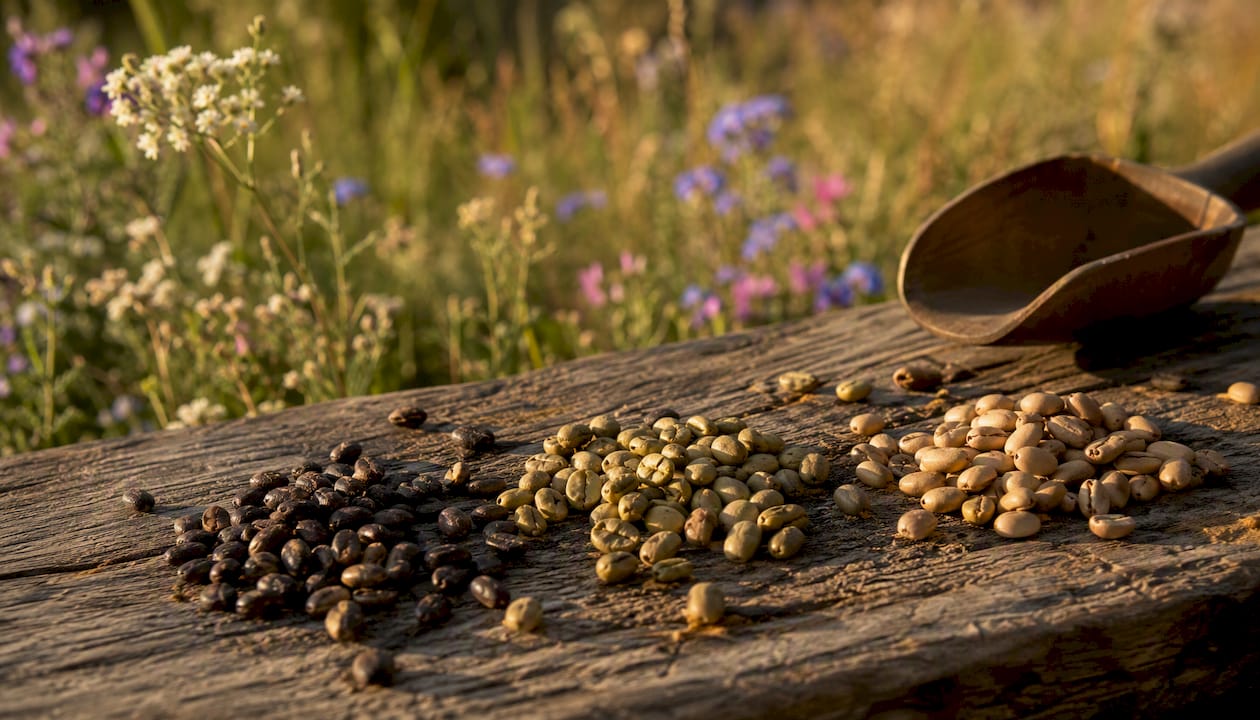
Laurina (Bourbon Pointu)
Laurina is a natural mutation of Bourbon Arabica, originally from Réunion Island. Sprudge reports that it carries notably lower caffeine than standard Arabica, typically cited in the 0.2–0.6% range by dry weight. The flavor profile rewards the price: delicate sweetness, bright acidity, and a clean finish with almost no bitterness. That lack of bitterness is directly tied to the low caffeine, since caffeine is one of coffee’s primary bitter compounds.
The catch is availability. Laurina plants yield less fruit, are more vulnerable to pests, and require careful cultivation. That combination keeps supply tight and prices high. When you do find it, expect to pay specialty-tier prices, and treat it as a tasting experience rather than an everyday cup.
Coffea eugenioides
This is one of the two parent species of Arabica (the other being Coffea canephora, i.e., Robusta). On its own, eugenioides contains very low caffeine, roughly 0.2–0.4% by dry weight, and produces a cup that is notably sweet, almost syrupy, with low acidity and very little bitterness. It gained attention after appearing in high-profile competition brews. Commercial availability is extremely limited; you will mostly find it through specialty micro-roasters or auction lots.
Coffea racemosa
Native to coastal Mozambique and parts of southern Africa, racemosa sits at the lower end of the caffeine spectrum, around 0.2–0.4% by dry weight. The flavor is light-bodied, slightly woody, and subtly fruity. It is rarely seen outside of research contexts and a handful of specialty importers. Worth trying if you encounter it, but do not plan a daily habit around it.
Aramosa and AC1
Aramosa is a hybrid of Arabica and Coffea racemosa, developed by Brazilian research institutions IAC and EMBRAPA to combine lower caffeine with better agronomics. AC1 is a related breeding line from the same programs. Both carry reduced caffeine compared with standard Arabica and are more commercially viable than wild species like racemosa, though they are still not widely available in U.S. retail. These are promising, but the commercial scale is not there yet.
Excelsa (Coffea liberica var. dewevrei)
Excelsa is sometimes grouped with low-caffeine varieties, though its caffeine content is closer to Arabica than to Laurina or eugenioides. Its real distinction is flavor: tart, fruity, almost wine-like, with a full body. It shows up in some Southeast Asian blends. Worth knowing about, but it is not a reliable low-caffeine choice on its own.
Naturally low-caffeine varieties taste sweeter and less bitter than standard Arabica because caffeine itself contributes bitterness. If you have ever found specialty coffee too sharp or aggressive, a naturally low-caffeine variety might genuinely change your experience of the drink.
How decaf and half-caff work, and what you give up
Decaffeination methods
Three main processes dominate the industry, and they produce meaningfully different cups.
Swiss Water Process uses no chemicals. Green beans are soaked in a flavor-charged water solution that draws out caffeine while leaving most flavor compounds behind. The result is clean and well-preserved. It is the preferred method among specialty roasters and the one most commonly seen on quality decaf bags.
CO2 (supercritical carbon dioxide) process is the most precise. Pressurized CO2 selectively bonds with caffeine molecules and removes them with minimal flavor disruption. It is expensive, which is why it appears mainly on premium decaf. Flavor fidelity is high, and the resulting cup is often indistinguishable from the caffeinated original.
Solvent-based methods (ethyl acetate or methylene chloride) are cheaper and widely used in commercial decaf. Ethyl acetate is sometimes marketed as “natural” since it occurs in fruit. Flavor outcomes vary; some drinkers notice a slightly flat or chemical note, others do not. Residual solvent levels in finished coffee are well below FDA thresholds, but the perception issue is real in the specialty market.
All three methods leave a small residual caffeine amount, typically 2–15 mg per 8-oz cup, compared with 80–120 mg in regular brewed Arabica.
Half-caff: the practical middle ground
Half-caff means exactly what it sounds like: a blend of caffeinated and decaffeinated beans, usually in equal parts. The caffeine math is straightforward. If a full-caff cup delivers 100 mg, a half-caff version of the same blend delivers roughly 50 mg. You control the ratio, which makes it the most predictable caffeine-reduction strategy available.
Pros and cons at a glance:
- Half-caff pros: familiar flavor, easy to dial in, no sourcing challenges, works with any bean you already like
- Half-caff cons: still contains meaningful caffeine, flavor depends on decaf quality used in the blend
- Decaf pros: near-zero caffeine, widely available, improving in quality year over year
- Decaf cons: small residual caffeine, flavor can differ from the caffeinated original depending on the process
- Naturally low-caff pros: no processing, often sweeter and more delicate, a genuinely different sensory experience
- Naturally low-caff cons: expensive, hard to find, caffeine reduction is real but not as dramatic as decaf
Roast level and serving size: the myths worth correcting
Dark roast does not mean less caffeine. This is probably the most persistent misconception in coffee.
Here is what actually happens: roasting drives off moisture and CO2, so a dark-roasted bean weighs less than a light-roasted bean from the same lot. If you measure by weight, dark and light roast contain roughly similar caffeine percentages. If you measure by volume (scoops), dark roast beans are physically larger and less dense, so a scoop of dark roast holds fewer beans and slightly less caffeine. The practical difference is small compared with what you get from changing dose or species.
A simple example: standard Arabica runs about 1.2% caffeine by dry weight. A 15-gram dose at 20% extraction efficiency yields roughly 36 mg of caffeine extracted into the cup. Drop the dose to 10 grams with the same extraction and you get roughly 24 mg. That 5-gram dose reduction does more than switching from light to dark roast ever could.
The action line: if you want less caffeine, reduce your dose first, then consider brew method, then species. Roast is the last variable worth worrying about.
How to brew for less caffeine without wrecking the flavor
These steps work with whatever beans you already have. Apply them in order for the biggest impact.
-
Reduce your dose. Drop from the standard 1:15 coffee-to-water ratio to 1:18 or 1:20. For a 12-oz cup, that means moving from about 20 grams of coffee to 14–16 grams. You will notice a lighter body but not necessarily less flavor if you adjust grind size to compensate.
-
Grind coarser. A coarser grind slows extraction and pulls less caffeine per minute of contact time. Pair a coarser grind with a slightly longer brew time to maintain flavor without maximizing caffeine extraction.
-
Shorten brew time. Caffeine extracts quickly. In a pour-over, cutting your total brew time by 30–45 seconds reduces caffeine without gutting the cup. In a French press, try 3 minutes instead of 4.
-
Choose a gentler brew method. An AeroPress with a short 60–90 second steep and a coarser grind can produce a lower-caffeine cup than some standard drip methods due to reduced extraction time. The physics favor you: less contact time, less extraction.
-
Blend in decaf. Start at 25% decaf to 75% regular, then move to 50/50 if you want to cut further. This is the half-caff approach, and it scales precisely with your ratio.
-
Use water just off the boil, not at a full rolling boil. Water at 195–200°F extracts slightly less aggressively than 212°F water. The difference is modest, but it adds up alongside other adjustments.
Pro Tip: Cold brew is often assumed to be lower in caffeine because it is smoother. It is not. Cold brew typically uses a higher coffee-to-water ratio and a long steep (12–24 hours), which can produce more caffeine per ounce than hot brew. If you want cold brew with less caffeine, cut the dose by 30% and dilute more aggressively at serving.
How to shop for coffee with less caffeine
A short checklist for buying online or in a specialty shop:
- Read the label language carefully. “Naturally low-caffeine” means the variety itself is low-caffeine (Laurina, eugenioides, etc.). “Decaf” means the caffeine was removed after harvest. “Half-caff” means a blend. These are not interchangeable.
- Ask for mg-per-cup data. Reputable roasters can often provide this, or at least the caffeine percentage of the green bean. If a roaster cannot tell you anything about caffeine content, that is a gap worth noting.
- Check the decaf process. Swiss Water and CO2 are the quality benchmarks. If the bag does not say, ask.
- Look at origin and producer notes. A roaster who names the farm, the variety, and the processing method is more likely to know what is actually in the bag.
- Flag rarity and price. Laurina and eugenioides will cost more than standard Arabica decaf. If a bag claims to be Laurina at commodity prices, be skeptical.
Questions worth asking your roaster: “Is this a naturally low-caffeine variety or a decaffeinated bean?” and “Can you share the caffeine percentage of the green bean or an estimated mg per serving?”
When to choose Eastviewcoffee’s decaf or half-caff over hunting rare varietals: if your goal is consistent daily caffeine reduction with good flavor, decaf and half-caff from a quality roaster will serve you better than an expensive, hard-to-source Laurina. Save the rare varietals for when you want to explore what low-caffeine coffee can taste like at its ceiling.
What quality low-caffeine coffee looks like: Eastviewcoffee as an example
Eastviewcoffee, roasted in small batches in Kenosha, Wisconsin, offers both decaffeinated and half-caff options alongside its single-origin and seasonal releases. Their Half-A$$ed Half-Caff is a practical example of what a well-executed blend looks like: a 50/50 mix that delivers roughly half the caffeine of a standard cup without asking you to compromise on roast quality.
What makes Eastviewcoffee’s sourcing worth paying attention to:
- All coffee is sourced from women-owned farms, with premium compensation built into the supply chain, not tacked on as marketing.
- Small-batch roasting means each lot is evaluated individually, which matters when you are buying decaf. A poorly roasted decaf tastes flat; a carefully roasted one does not.
- The seasonal collection occasionally includes single-origin picks that skew toward naturally sweeter, lower-bitterness profiles, which overlaps with what low-caffeine drinkers are often looking for even when the variety itself is not a botanical outlier.
When evaluating any roaster’s low-caffeine offering, look for three things: transparency about the decaf process, named origin and producer, and a roast date on the bag. Eastviewcoffee checks all three.
The case for starting with what you can actually buy
The naturally low-caffeine variety conversation is genuinely exciting, and Laurina in particular deserves the attention it gets. But there is a gap between what the specialty coffee world talks about and what most drinkers can realistically put in their grinder on a Tuesday morning.
The honest truth is that Coffea eugenioides and racemosa are research curiosities for most U.S. coffee drinkers right now. They are worth trying if you encounter them, but building a caffeine-reduction strategy around them is like planning your diet around a restaurant that has a three-month waitlist. The flavor payoff is real. The accessibility is not.
Half-caff and quality decaf, on the other hand, are available today, they work predictably, and when sourced from a roaster who treats decaffeination as seriously as the original roast, they taste genuinely good. The Swiss Water and CO2 processes have improved significantly, and the gap between a well-roasted decaf and its caffeinated counterpart has narrowed, often making them indistinguishable in taste for many drinkers.
What I would push back on is the idea that choosing decaf or half-caff is settling. For most people with a real caffeine sensitivity or a health reason to reduce intake, it is the smarter, more sustainable choice. The rare varietals are for curiosity. The blends and decafs are for life.
Eastviewcoffee’s decaf and half-caff are worth trying
If you have been cutting back on caffeine but dreading the flavor tradeoff, Eastviewcoffee’s small-batch approach changes the equation. Their decaf collection is sourced from women-owned farms and roasted with the same care as their full-caff single origins. The Half-A$$ed Half-Caff gives you a 50/50 blend that is ready to brew without any measuring or mixing on your end.
Both options ship directly to your door. If you are not sure which one fits your caffeine goals, Eastviewcoffee makes it easy: get a custom coffee recommendation and they will point you toward the right roast, blend, and brewing approach for where you are right now.
Sources
- Naturally Low-Caffeine Coffee
- What Is Laurina Coffee? | Sprudge Coffee
- Exploring Coffees with Lower Caffeine: Varieties, Roasts, and Brewing Tips
- Exploring Naturally Low-Caffeine Coffee Varieties