
The Real Guide to Eco-Friendly Coffee Packaging for Small Roasters
For most small and medium roasters, a certified compostable kraft doypack or a certified mono-PE recyclable pouch, paired with clear disposal labeling, gives you the best balance of freshness and end-of-life performance. Your final call depends on two things: how long your coffee sits before it’s brewed, and whether your customers actually have access to industrial composting or a soft-plastic recycling drop-off. Verify certifications before you sign a purchase order. Jump to the materials breakdown below for the specifics.
TL;DR:
- Certified compostable kraft doypacks and mono-PE recyclable pouches offer the best balance of freshness and end-of-life options for small and medium roasters, depending on local composting or recycling access.
- PHA delivers biodegradable performance in marine, soil, and home composting environments, making it the best choice for open-environment scenarios.
- Barrier performance, measured by oxygen and water vapor transmission rates, is crucial; a degassing valve and appropriate packaging format extend coffee freshness.
- Packaging claims should be verified through certification numbers like ASTM D6400, EN 13432, or BPI, with supplier reports to ensure true compostability.
- Labeling must clearly instruct proper disposal methods, matching material certifications, and should be updated seasonally to remain accurate.
Table of Contents
- What Are the Best Eco-Friendly Coffee Packaging Materials?
- Which Packaging Format Actually Protects Roasted Coffee?
- How Do You Verify Compostable and Biodegradable Claims?
- How Do You Buy Sustainable Packaging Without Overpaying?
- How Should You Label Packaging for Proper Disposal?
- What Really Happens to Coffee Packaging After Disposal?
- How East View Coffee Approaches Packaging Choices
- A Four-Step Plan If You’re Ready to Switch Packaging
- See Sustainable Packaging in Action at East View Coffee
- Sources
- FAQ
What Are the Best Eco-Friendly Coffee Packaging Materials?
Four material families dominate the market right now, and each one solves a different problem.
PLA (polylactic acid) is a plant-based plastic that performs well in industrial composting facilities but struggles outside them. It needs sustained heat and moisture to break down, so it’s a poor fit if your customers only have backyard compost bins.
PHA (polyhydroxyalkanoate) is the more flexible cousin. Suppliers like Pure Form Solution market PHA as capable of biodegrading in marine, soil, home, and industrial settings without leaving microplastic residue, which makes it one of the few materials with a credible open-environment claim. That matters if your bags end up in a landfill or, worse, a waterway.
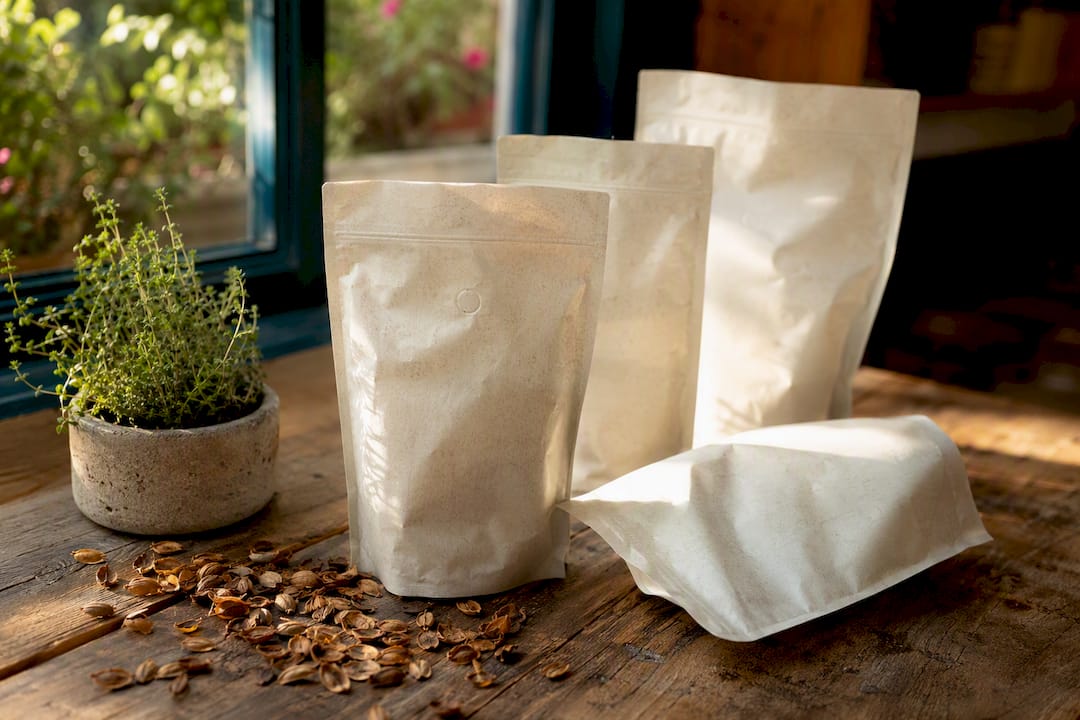
Mono-PE (mono-material polyethylene) isn’t compostable, but it’s designed for existing plastic-film recycling streams, which are far more widespread than industrial composting access in most U.S. cities.
Kraft paper with a bio-film liner gives you the rustic look customers associate with sustainability, and suppliers such as Achieve Pack offer versions certified to EN 13432 and ASTM D6400 with valve compatibility built in.
- Need marine/soil safety and open-environment breakdown? Choose PHA.
- Need access to a broad recycling stream instead of relying on compost drop-off? Choose mono-PE.
- Need a rustic retail look with real compostability? Choose kraft with a compostable bio-film.
- Selling mostly online with long transit times? Prioritize barrier performance over compostability alone.
Pro Tip: Test your degassing valve and zipper on any new compostable film before committing to a full run. Compostable liners shift seal strength and valve release pressure compared to conventional foil laminates, and a bad seal ruins freshness faster than any material choice.
Which Packaging Format Actually Protects Roasted Coffee?
Format matters as much as material. Roasted coffee off-gasses carbon dioxide for days after roasting, and it absorbs oxygen and moisture if the barrier isn’t right.
Two numbers govern this: OTR (oxygen transmission rate) and WVTR (water vapor transmission rate). Lower numbers mean a tighter barrier, and both should be part of any spec sheet a supplier hands you. A one-way degassing valve lets built-up CO2 escape without letting oxygen back in, and it’s non-negotiable for any bag holding freshly roasted whole bean or ground coffee sold within a day or two of roasting.
- Flat-bottom bags: strongest barrier, best shelf presence, higher cost per unit. Good for retail shelves and gift sets.
- Doypacks (stand-up pouches): solid barrier, lower cost than flat-bottom, easiest to print custom graphics on. Works well for subscriptions and e-commerce.
- Tins: excellent barrier and reusable by the customer, but heavy and expensive to ship, so they fit tasting-room retail better than mail order.
- Flat pillow bags: cheapest option, weakest barrier, best reserved for short shelf-life or wholesale programs with fast turnover.
If you’re shipping subscriptions across the country, prioritize a doypack with a validated valve and low OTR over a cheaper flat bag that saves pennies but sacrifices two weeks of shelf life.
How Do You Verify Compostable and Biodegradable Claims?
“Biodegradable” on its own means almost nothing. The term isn’t strictly defined in most U.S. regulations, and the FTC’s Green Guides caution against unqualified biodegradable claims because most packaging won’t break down meaningfully in a landfill regardless of what the bag says.
What you actually want are certification numbers you can verify:
- ASTM D6400: U.S. standard for compostability in industrial facilities.
- EN 13432: the European equivalent, often cited alongside ASTM D6400 on the same spec sheet.
- BPI (Biodegradable Products Institute): third-party certification confirming ASTM D6400 compliance, with a searchable database of approved products.
- TÜV OK Compost Home: the specific mark to look for if you’re claiming your bag works in a backyard compost pile, not just an industrial facility.
Ask every supplier for the certificate number and the testing lab’s report, not just a logo on a spec sheet. A logo without a number is a claim you can’t defend if a customer or regulator asks.
How Do You Buy Sustainable Packaging Without Overpaying?
Cost per unit drops fast once you get past the pilot stage, but the biggest lever is combining SKUs on shared tooling. If your 12-ounce and 5-pound bags use the same film and just swap size, you cut plate and setup costs significantly. Digital printing costs more per unit than gravure but eliminates the plate fees that make small runs painful.
- Request samples from two or three suppliers, including Elevate Packaging’s coffee bag line for a sense of pricing and MOQ ranges available to smaller roasters.
- Run a shelf test: fill bags with your actual roast, seal them, and check flavor and aroma at two, four, and eight weeks.
- Order a small production run (often 500 to 1,000 units for compostable films) before committing to a bulk purchase.
- Scale up only after you’ve confirmed seal integrity and valve performance under your specific roasting profile.
Ask suppliers directly about certification documentation, minimum order quantities, standard lead times, and whether their valve is rated for your typical roast-to-pack window.
How Should You Label Packaging for Proper Disposal?
Your bag is the only instruction manual most customers will ever read. If it doesn’t say exactly what to do, they’ll guess, and they’ll usually guess wrong.
Write disposal copy that matches the material precisely: “Compostable in industrial facilities only, check locations at [findacomposter.com]” reads very differently from “Widely recyclable through store drop-off programs, not curbside.” Vague phrasing like “eco-friendly” or “green” on its own tells the customer nothing actionable.
- Print a QR code linking to a page with your certification numbers and local disposal instructions.
- Choose natural kraft if brand storytelling matters more than print detail; choose a white base film if you need sharp, colorful graphics.
- State the disposal method in plain language, not just a resin code.
Pro Tip: Update your QR code destination seasonally if your certification or supplier changes. A dead link on a bag that’s already shipped is worse than no QR code at all.
What Really Happens to Coffee Packaging After Disposal?
Here’s the uncomfortable truth: most compostable coffee bags in the U.S. never reach an industrial composting facility, because access to that infrastructure remains limited in many regions. A bag certified to ASTM D6400 that ends up in a landfill breaks down about as slowly as anything else there, since landfills lack the oxygen and moisture composting requires.
Recycling has its own gap: most curbside programs don’t accept flexible plastic film, so mono-PE bags typically need a store drop-off program, not a blue bin.
- PHA has the strongest case for open-environment scenarios like marine or soil exposure, based on supplier degradation testing.
- PLA needs an industrial facility to perform as advertised; without one nearby, it behaves like ordinary plastic waste.
- Mono-PE only delivers its recycling benefit if customers use a drop-off point instead of curbside.
The circular economy framework exists precisely because material choice matters less than whether that material actually gets back into productive use, and keeping materials in circulation reduces both emissions and waste. A supplier takeback program or a clear local drop-off partnership does more for the planet than a certification logo ever will. Some roasters also point customers toward creative reuse ideas for spent coffee grounds as a complementary way to close the loop at home.
How East View Coffee Approaches Packaging Choices
Eastviewcoffee roasts in small batches out of Kenosha, Wisconsin, and packaging decisions get made with the same scrutiny as sourcing decisions. The company evaluates barrier performance and disposal realities together rather than choosing the trendiest material and hoping the label sorts out the rest, a practice detailed on its packaging page.
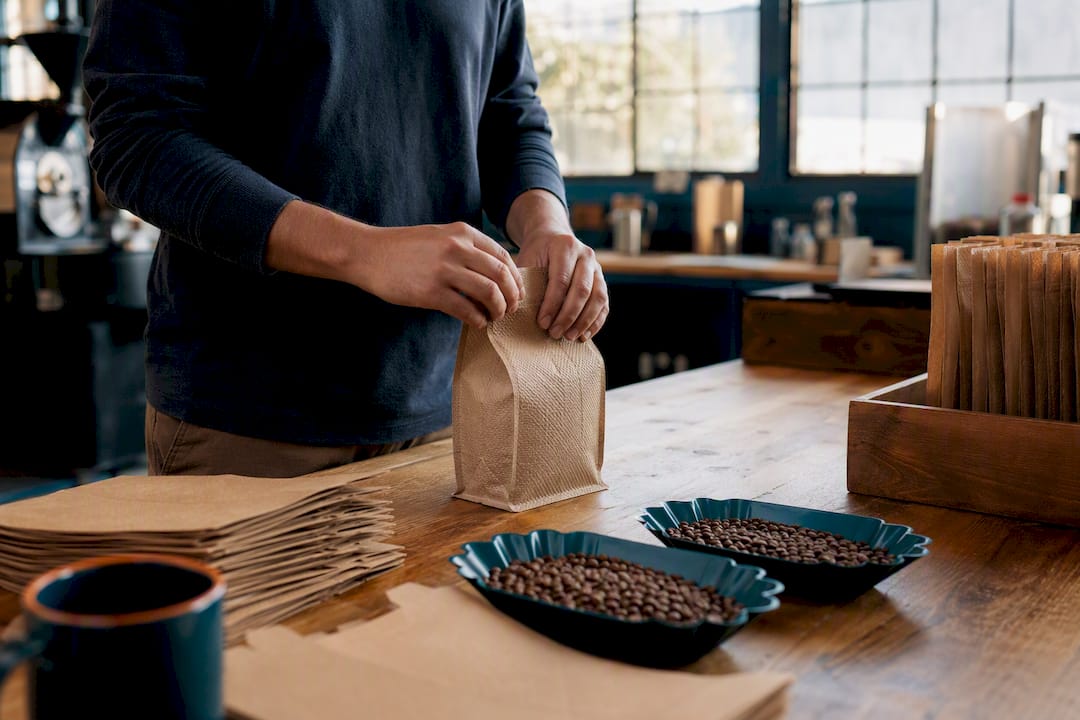
The lesson other roasters can borrow directly: pick your packaging format around your actual shelf-life needs first, then layer in the most sustainable certified material that still meets that barrier requirement. Chasing sustainability first and freshness second tends to produce stale coffee in a compostable bag, which helps no one and refunds nobody.
A Four-Step Plan If You’re Ready to Switch Packaging
If you’re a roaster ready to move, don’t overhaul everything at once. Order samples in two materials this month. Run an eight-week shelf test on your best-selling roast. Measure flavor retention and valve performance before you commit to a production run. Then scale only the format that held up.
Pro Tip: Perfection isn’t the goal on your first pass. A pilot run that teaches you something concrete beats a perfect-on-paper plan that never leaves the spreadsheet.
— Jenny
See Sustainable Packaging in Action at East View Coffee
Reading about certifications is one thing. Holding a bag that actually delivers on them is another. Eastviewcoffee builds its packaging decisions around the same freshness-versus-footprint tradeoffs covered in this guide, and you can see those choices firsthand across the product line.
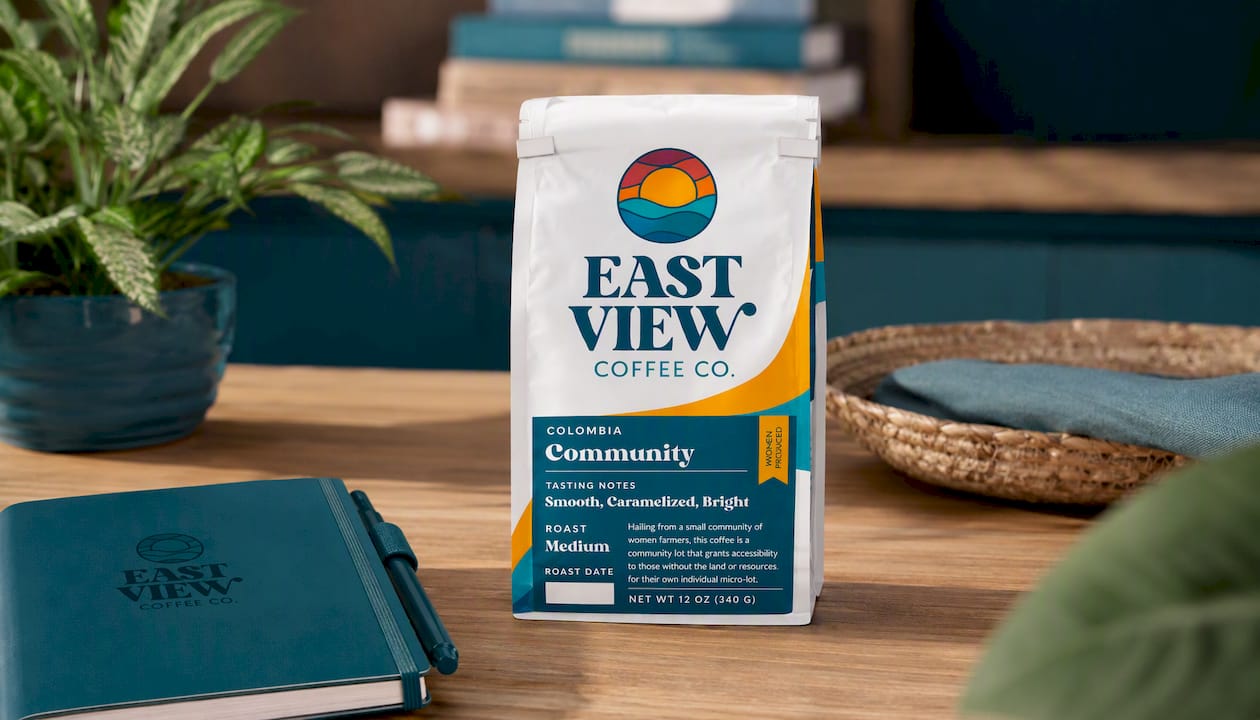
The Cat’s Pajamas Half-Caff Freshly Roasted Coffee, the Sunny’s Choice Bundle, and the Half-A$$ed Half-Caff Freshly Roasted Coffee all ship in the packaging formats discussed above, so you can evaluate barrier performance and disposal labeling on a real product instead of a spec sheet. Browse the full packaging page for details on certifications and materials, or check the seasonal coffee collection to see how format choices shift across different roasts. If you’re a wholesale buyer or fellow roaster with packaging questions, reach out through the custom coffee recommendation page to start the conversation.
Sources
For verification, keep these on hand: ASTM D6400, EN 13432, BPI, and TÜV OK Compost. The Ellen MacArthur Foundation and EPA composting guidance cover circular-economy and disposal fundamentals. Supplier specs are available from Achieve Pack and Pure Form Solution.
- Ellen MacArthur Foundation — Circular economy overview
- UNDP — What is circular economy and how it helps fight climate change
- Pure Form Solution — PHA coffee bags
FAQ
What Are Examples of Eco-Friendly Packaging?
Certified compostable kraft doypacks, PHA pouches, and mono-PE recyclable bags are the three most common formats specialty coffee roasters use today, each suited to different disposal infrastructure.
What Is the Best Packaging for Coffee?
For most small and medium roasters, a certified compostable kraft doypack or mono-PE recyclable pouch with a functioning degassing valve offers the strongest balance of shelf life and end-of-life performance; Eastviewcoffee applies this same logic across its product line.
Are There Any Plastic-Free Coffee Bags Available?
Yes. Kraft paper bags with compostable bio-film liners and PHA-based pouches are both marketed as plastic-free alternatives, though PHA suppliers note it can still require specific composting or marine conditions to fully biodegrade.
What Are the Regulations for Coffee Packaging?
The FTC’s Green Guides caution against unqualified “biodegradable” claims, so U.S. roasters should back any compostability claim with a verifiable ASTM D6400, EN 13432, or BPI certification number rather than marketing language alone.
Can Coffee Bags Be Recycled?
Only specific formats, mainly mono-PE bags, qualify for recycling, and typically through store drop-off programs for flexible film rather than standard curbside pickup.
Are Coffee Bags Compostable?
Some are, but only if they carry ASTM D6400 or EN 13432 certification and are disposed of through an industrial composting facility, unless they also carry a TÜV OK Compost Home mark for backyard composting.