
Under 30 Minutes: Sustainable Morning Routine With Coffee Ritual
Drink water before coffee, get outside for 10 to 15 minutes of morning light, move your body for another 10 to 15 minutes, and let your phone sit untouched for the first half hour. Add a slow, mindful coffee ritual with a low-waste brew method, and you have a sustainable morning routine that costs nothing extra and takes under 30 minutes. Pick two of these to start. Everything else can wait.
TL;DR:
- Drinking 250 to 500 ml of water immediately after waking improves hydration and enhances coffee’s effectiveness by supporting better brain function.
- Spending 10 to 15 minutes outdoors within half an hour of waking helps regulate circadian rhythms and promotes better sleep, requiring no purchase or equipment.
- Incorporating 10 to 15 minutes of light movement or walking outside boosts mood, blood flow, and cognitive sharpness, especially when combined with outdoor light exposure.
- Delaying phone use for 30 to 60 minutes prevents attention residue, improving focus and mental clarity for the rest of the morning routine.
- Choosing low-waste personal care products and swapping disposable items for reusable alternatives significantly reduces weekly and yearly morning waste without high costs.
Table of Contents
- What Does a Sustainable Morning Routine Actually Look Like?
- How Do You Build a Sustainable Coffee Ritual?
- What Zero-Waste Swaps Cut the Most Morning Trash?
- How Do You Make a Sustainable Morning Routine Stick?
- Quick Routine Templates by Time Budget
- How Do You Plan for a Sustainable Day Ahead?
- Do Clothing Choices Belong in a Sustainable Morning Routine?
- How Can You Cut Energy Use During Your Morning Routine?
- Why Does Outdoor Time Matter So Much in the Morning?
- Publisher Perspective: What East View Coffee Company Believes About Mornings
- Start Your Ritual With Coffee Worth Repeating
- Sources
- FAQ
What Does a Sustainable Morning Routine Actually Look Like?
A sustainable morning routine isn’t about waking up at 5 AM or journaling for an hour. It’s about a short sequence of habits that support your body, cost little, and produce almost no waste, repeated daily until they run on autopilot. The habits below are ranked roughly by impact, so if you only adopt three, start from the top.
1. Hydrate before you caffeinate. Your body loses water overnight through breathing and sweat, and even mild dehydration of 1 to 2% measurably slows down thinking and reaction time. Drinking 250 to 500 ml of water right after waking rehydrates your brain before you reach for coffee, which means the caffeine you drink later works better instead of just masking fatigue. Keep a reusable glass or bottle by your bed the night before. That’s the whole habit.
2. Get real daylight within 30 minutes of waking. Ten to 15 minutes of outdoor light, or at minimum standing by a bright window, helps set your circadian clock for the day and supports better sleep that night, according to circadian rhythm research. This is one of the cheapest, most evidence-backed morning habits available, and it requires zero purchases. Step onto a porch, balcony, or sidewalk. Even a cloudy sky delivers more light than indoor bulbs.
3. Move for 10 to 15 minutes. You don’t need a workout. Short bursts of light movement, a walk, stretching, a few sun salutations, boost blood flow, mood, and cognitive sharpness almost immediately, per research on brief exercise and cognition. Pair this with step two by walking outside instead of stretching indoors, and you’ve stacked two habits into one block of time.
4. Delay your phone for 30 to 60 minutes. Checking email or social media first thing creates what researchers call attention residue: your brain keeps processing that content even after you’ve moved on, which drags down focus on whatever you do next. Leave your phone in another room overnight if you can. It’s a free habit that pays off in mental clarity all morning.
5. Swap in low-waste personal care. This doesn’t require a full bathroom overhaul. A few examples that make a real dent:
- Bamboo toothbrush instead of plastic
- Shampoo or soap bars instead of bottled liquids
- Refillable containers for lotion or toothpaste tabs
- A safety razor instead of disposable plastic ones
6. Build a simple, low-waste breakfast. Reach for oats, fruit, or leftovers stored in reusable containers rather than individually wrapped snacks. Choosing seasonal, less-processed food consistently carries a lower carbon footprint than packaged alternatives, according to Our World in Data’s analysis of food choice and climate impact. If you want fresh ideas beyond toast and cereal, Wild Foodz’s seed-based meal ideas offer plant-forward options that travel well in a reusable jar.
7. Make coffee a ritual, not a rush. This is the habit most people treat as an afterthought and the one with the most room for both enjoyment and waste reduction. More on that below.
How Do You Build a Sustainable Coffee Ritual?
Coffee doesn’t have to be the wasteful part of your morning. The brew method you choose matters almost as much as the beans, and the ritual around it matters more than most people realize.
French press, pour-over with a reusable metal or cloth filter, and AeroPress all beat pod machines and disposable paper filters on waste, and each brings a different trade-off:
- French press: richest body, zero filters needed, but grounds require a bit more cleanup.
- Pour-over with a reusable filter: cleaner cup, fast, and the filter lasts for years instead of landing in the trash daily.
- AeroPress: fastest cleanup, travel-friendly, though it typically still uses small paper filters unless you switch to a metal one.
Whichever method you pick, the grounds don’t have to go straight into the trash. They compost well, work as a mild garden fertilizer, and can even scrub grease off pans. Eastviewcoffee has a full guide to reusing coffee grounds worth bookmarking if you want to close that loop entirely.
There’s also a timing case worth making. Waiting 30 to 90 minutes after waking before your first cup lets your natural cortisol curve do some of the alertness work caffeine usually gets credit for, and it means you approach the ritual calmer rather than groggy and rushed. A mindful approach to coffee built on smell, warmth, and a quiet few minutes delivers real psychological benefits even with lower-caffeine beans, which is part of why half-caff options work well for a ritual focused on presence rather than a jolt.

Pro Tip: Pick one spot in your home for coffee, the same chair or counter every day, and pair it with one small act like journaling three lines or just sitting without your phone. The consistency of place does more for the ritual than the coffee itself.
What Zero-Waste Swaps Cut the Most Morning Trash?
Most morning waste comes from single-use items you replace weekly or monthly instead of once a year. Swapping the highest-frequency items delivers the biggest cut.
Bathroom swaps with the most impact:
- WaterSense-certified low-flow showerheads reduce both water and the energy used to heat it, based on EPA guidance on water-efficient fixtures.
- Shampoo and conditioner bars eliminate plastic bottles entirely over a year of use.
- A bamboo toothbrush replaces a plastic one every three months without adding to landfill.
Kitchen swaps worth making:
- Buying coffee, oats, and nuts in bulk or larger bags cuts packaging per serving.
- Reusable containers for breakfast replace foil, cling wrap, or zip bags.
- Switching from pods to a French press or reusable filter, as covered above, removes hundreds of disposable filters or capsules a year.
None of this requires an expensive shopping trip. Small, repeated swaps, one toothbrush, one reusable bottle, compound over a year into meaningful waste reduction and savings, and starting with a single swap is what actually makes the habit stick.
Prepping the night before removes the friction that kills most morning routines. Set out your reusable mug, pre-measure your coffee grounds, and portion tomorrow’s breakfast into its container before bed. A shorter shower, closer to five minutes than fifteen, saves meaningful water over a year, especially paired with a WaterSense fixture.
How Do You Make a Sustainable Morning Routine Stick?
Most morning routines fail not because the habits are wrong, but because people try to adopt six new things at once. The fix is smaller than you’d think.
- Pick two anchor habits and practice them for 14 days before adding a third. Water and sunlight work well as a starting pair since they take under 20 minutes combined and need no equipment.
- Use habit stacking to attach new behavior to something automatic. For example: “After I turn off my alarm, I will drink a full glass of water.” Or: “After I pour my coffee, I will sit for two minutes before checking my phone.”
- Build in daily increments instead of jumping to the full routine. Week one might be water and light only. Week two adds movement. Week three adds the coffee ritual.
- Design a minimal backup version for bad days. On mornings when sleep was short or you’re traveling, water plus two minutes of light might be all you do, and that still counts.
- Watch for the two most common pitfalls: over-ambition and inconsistent sleep. Adding too many habits at once collapses the whole routine when one day goes sideways, and poor sleep undercuts your ability to stick to any morning plan regardless of how well-designed it is.
Pro Tip: If you miss a day, don’t restart your streak count from zero mentally. Just do the next morning’s routine. The habit survives interruption far better than most people assume, as long as you don’t treat one missed day as failure.
Quick Routine Templates by Time Budget
Not every morning allows for a full 30 minutes, so scale the routine to what you actually have.
5 minutes: Drink water immediately, take two minutes of slow breathing by a window, grab your reusable bottle on the way out.
10 minutes: Water first, then a 5 to 10 minute walk outside for light and movement combined, followed by a quick mindful coffee poured into a to-go mug you already own.
20 to 30 minutes: Water, 10 to 15 minutes of movement or a longer walk, a slower brewed coffee ritual using your French press or pour-over, and a breakfast prepped the night before in a reusable container.
Each version keeps the same order: hydrate, get light, move, then coffee. Compressing time just shortens each step rather than cutting it entirely.
How Do You Plan for a Sustainable Day Ahead?
The morning routine sets the tone, but a few extra minutes of planning extends that sustainability mindset into the rest of your day. Pack a reusable water bottle and coffee mug before you leave, so you’re not tempted by a disposable cup at a coffee shop later. Glance at your calendar and note which meals you’ll need, then pack leftovers or a snack in a container instead of buying something wrapped in plastic at lunch.
If you’re commuting, decide now whether walking, biking, or carpooling is realistic for today rather than defaulting to driving alone out of habit. Even choosing one lower-impact trip a week adds up. Laying out your outfit the night before also saves morning decision fatigue, which ties directly into the clothing habits covered next.
A five-minute mental walk-through of your day, what you’ll eat, how you’ll get around, what you’ll need, turns sustainability from a morning-only practice into something that follows you past 9 AM. It also reduces the odds you’ll grab a wasteful convenience option out of last-minute stress.
Do Clothing Choices Belong in a Sustainable Morning Routine?
Yes, and it’s an easy one to overlook. What you put on in the morning carries its own environmental footprint, from water used in production to how long a garment actually stays in rotation before landfill.
A few habits make a real difference without requiring a wardrobe overhaul:
- Choose durability over trend cycles. Clothes made to last several years beat cheap items replaced every season, both financially and environmentally.
- Lay out your outfit the night before. This reduces decision fatigue and rushed choices, and it pairs naturally with the sustainable day planning above.
- Favor natural or recycled fibers when replacing items. Organic cotton, linen, and recycled synthetics generally carry a lighter production footprint than virgin synthetic fabric.
- Wash less often and on cooler cycles. Most clothes don’t need washing after a single light wear, and cold cycles use meaningfully less energy than hot ones.
None of this requires buying new “sustainable” clothing right away. The most eco-friendly garment is almost always the one already in your closet. Extending the life of what you own, through repair, careful washing, and thoughtful layering, does more for your footprint than any single purchase.
How Can You Cut Energy Use During Your Morning Routine?
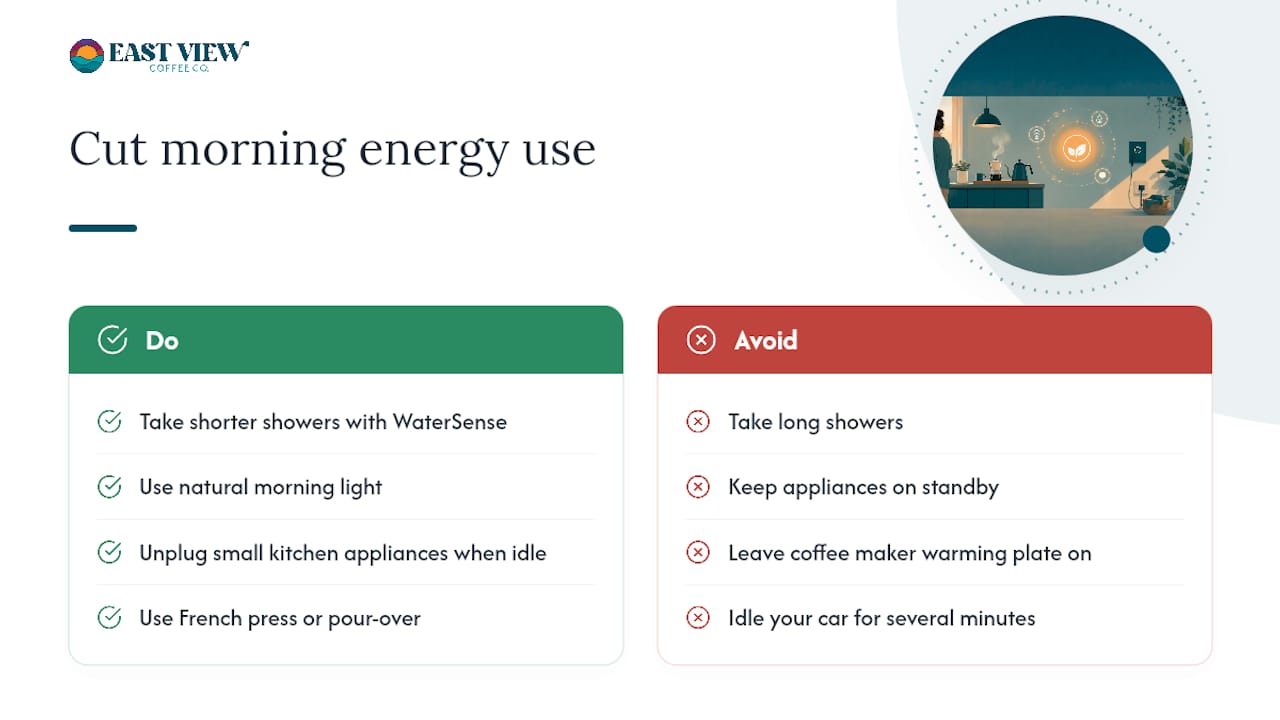
Mornings are energy-heavy by default: lights, hot water, appliances, and often a car all firing at once in a short window. A few adjustments shave that down without adding effort.
Shorter showers paired with a WaterSense-certified showerhead cut both water use and the energy needed to heat it, since water heating is one of the biggest energy draws in a typical morning. Letting natural light do the work instead of flipping on every bathroom and kitchen light adds up over a year, especially if your morning routine already includes stepping outside for sunlight anyway.
Unplug or switch off small kitchen appliances that don’t need to stay on standby, coffee makers with always-on warming plates being a common offender. A French press or pour-over setup sidesteps this entirely since there’s no electricity involved at all. If you drive to work, giving your car a minute to warm up rather than five wastes less fuel in most modern engines, which don’t need long idle periods to run properly.
None of these changes are dramatic on their own. Stacked together across a year, though, they meaningfully lower the energy footprint of a routine that happens 365 mornings a year whether you think about it or not.
Why Does Outdoor Time Matter So Much in the Morning?
Nature exposure in the morning does double duty: it delivers the circadian light benefits covered earlier and gives you a mental reset before the day’s demands start. Even five minutes on a porch or a short walk around the block counts.
If you have access to a yard, garden, or nearby park, use it. Tending a few plants, listening for birds, or simply sitting outside with your coffee stacks the ritual and the outdoor-time habit into one block instead of two separate to-dos. Sound, temperature change, and natural light activate your senses in a way that scrolling indoors doesn’t come close to matching.
For apartment dwellers without a yard, a balcony, a nearby sidewalk, or even an open window with a breeze still delivers meaningful exposure. The goal isn’t wilderness. It’s a few minutes of unfiltered light and air before your day turns into screens and interior rooms. Combined with the movement habit from earlier, a short outdoor walk covers two of your core habits in a single 10 to 15 minute block, which is exactly the kind of stacking that makes a sustainable morning routine realistic to keep long-term rather than something you abandon after a week.
Publisher Perspective: What East View Coffee Company Believes About Mornings
We build our business around small-batch coffee roasted in Kenosha, Wisconsin, sourced from women-owned farms who receive premium compensation for their harvest. That model taught us something about mornings: the habits that last are the ones tied to relationship and repetition, not gear or perfection. A sustainable morning routine succeeds the same way our sourcing does, through consistency, fair effort, and small daily choices that add up. Keep it short. Keep it repeatable. That’s the whole philosophy.
— Jenny
Start Your Ritual With Coffee Worth Repeating
Making the mindful coffee ritual easier to keep can involve using a subscription service to avoid scrambling for beans or defaulting to a wasteful pod on a rushed morning. If you’re building a lower-caffeine ritual focused on presence rather than a jolt, the Cat’s Pajamas Half-Caff Freshly Roasted Coffee gives you full flavor with less caffeine to disrupt sleep later. Want variety without adding packaging waste per cup? The Sunny’s Choice Bundle covers several profiles in one shipment instead of separate one-off orders. And for another half-caff option that fits the same slow-morning approach, the Half-A$$ed Half-Caff Freshly Roasted Coffee rounds out the lineup.

A subscription through our single-origin coffee club also cuts packaging waste over time, since regular shipments in consistent bags beat sporadic store runs in mismatched packaging. Curious how our sourcing and shipping choices hold up? Our packaging and climate commitment pages lay out exactly what we do and why. Ready to build your ritual? Get a custom coffee recommendation and start tomorrow’s routine with a bag that fits it.
Sources
- EPA: Showerheads
- PMC article on morning light and circadian benefits
- PubMed: benefits of short-duration exercise for cognition
- Our World in Data: Food choice vs. eating local
FAQ
What Is Jeff Bezos’ One-Hour Morning Rule?
Bezos has described starting his day slowly, avoiding early meetings, and giving himself roughly an hour for coffee and unhurried thinking before diving into work. The core idea, protecting quiet time before screens and obligations take over, lines up directly with delaying your phone and building a calm coffee ritual.
What Is the 20/20/20 Rule for a Morning Routine?
One popular version calls for 20 minutes of movement, 20 minutes of reflection or planning, and 20 minutes of learning or reading, all done before the workday starts. Definitions vary across sources, so treat it as a flexible framework rather than a fixed formula, and scale it down using the 5 or 10 minute templates above if an hour isn’t realistic.
What Is the Healthiest Morning Routine?
The healthiest version combines hydration before caffeine, 10 to 15 minutes of morning light, and 10 to 15 minutes of light movement, all backed by research on circadian rhythm and cognitive performance. Layering in a low-waste coffee ritual, like the mindful brewing approach outlined above, adds sustainability without sacrificing the wellness benefits.
What Is Elon Musk’s Morning Routine?
Musk has described a routine with minimal fixed structure, often starting work early and prioritizing efficiency over ritual. It’s a useful contrast: a sustainable morning routine built on short, repeatable habits tends to hold up better long-term than one built entirely around output and speed.
Can a Sustainable Morning Routine Really Reduce Waste?
Yes. Swapping disposable coffee filters or pods for a French press or reusable filter, switching to shampoo bars, and packing breakfast in reusable containers each cut recurring single-use waste, and those small swaps compound meaningfully over a year.