
Do Coffee Beans Expire? Freshness and Storage Guide
Coffee beans do not become unsafe to drink like perishable foods such as meat or dairy. What actually expires is the flavor. Roasted beans are low-moisture by nature, which means harmful microbial growth is rare as long as the beans stay dry. What you lose over time is the aroma, brightness, and complexity that made the coffee worth buying in the first place.
Two processes drive that decline:
- Degassing: After roasting, beans release CO2 which temporarily protects them from oxygen exposure.
- Oxidation: Once CO2 escapes, oxygen causes the breakdown of flavor compounds over time.
The practical rule: if your beans are dry, mold-free, and smell like coffee (even dull coffee), they’re safe to brew. But “safe” and “good” are two different things. Roast date and whole-bean storage are the two levers that actually control quality.
Key Takeaways
Coffee beans don’t expire in a safety sense, but they do lose flavor fast — whole beans peak within 2–4 weeks of roasting, and proper storage makes the difference between a great cup and a flat one.
| Point | Details |
|---|---|
| Safety vs. quality | Dry, mold-free beans are safe to drink; “expiration” almost always means flavor loss, not a health risk. |
| Peak freshness window | Whole beans taste best within 2–4 weeks of the roast date; ground coffee fades within days of opening. |
| Storage rules | Keep beans whole, airtight, cool, and dark; avoid the refrigerator, which adds humidity and odors. |
| Freezing guidance | Portion into single-use packs, freeze once, and let sealed bags reach room temperature before opening to prevent condensation. |
| Eastviewcoffee approach | Small-batch roasting with printed roast dates and a subscription option keeps you consistently within the peak freshness window. |
Table of Contents
- Do coffee beans expire, or do they just go stale?
- How long do coffee beans actually stay fresh?
- How to store coffee beans at home
- Can you freeze coffee beans? The right way to do it
- When should you actually throw coffee beans away?
- Whole beans vs. ground coffee: which holds freshness longer?
- What the research and experts say about coffee freshness
- Fresh beans, delivered when it matters
- Sources
- FAQ
Do coffee beans expire, or do they just go stale?
The science here is straightforward. According to the Specialty Coffee Association, CO2 degassing is most rapid in the first few weeks after roasting. During that window, escaping gas pushes oxygen away from the bean’s surface. Once that CO2 is gone, oxidation accelerates and flavor compounds break down. Maillard and Strecker reactions during the roast create the aromatic molecules that give coffee its character. Those molecules are volatile, meaning they don’t stick around.
Grinding speeds everything up dramatically. When you grind a bean, you shatter it into hundreds of tiny particles, multiplying the surface area exposed to air. Ground coffee can go noticeably stale within a short time after grinding if left open. A sealed bag buys more time, but not much.
Roast level also plays a role. Darker roasts are more porous than lighter ones, so they degas and oxidize faster. A light roast from the same batch will often taste fresher a week longer than its dark-roast counterpart, according to guidance from Martha Stewart’s coffee storage guide.
Pro Tip: Check the roast date on the bag, not just the “best by” date. A bag roasted eight months ago with a “best by” date a year out is already well past its peak. Specialty roasters like Eastviewcoffee print the roast date because that’s the number that actually matters.
The strongest bloom on your espresso or pour-over happens when CO2 is still present in the bean. That visible bubbling when hot water hits fresh grounds isn’t just aesthetic — it’s a sign the coffee is still alive with gas and aroma.
How long do coffee beans actually stay fresh?
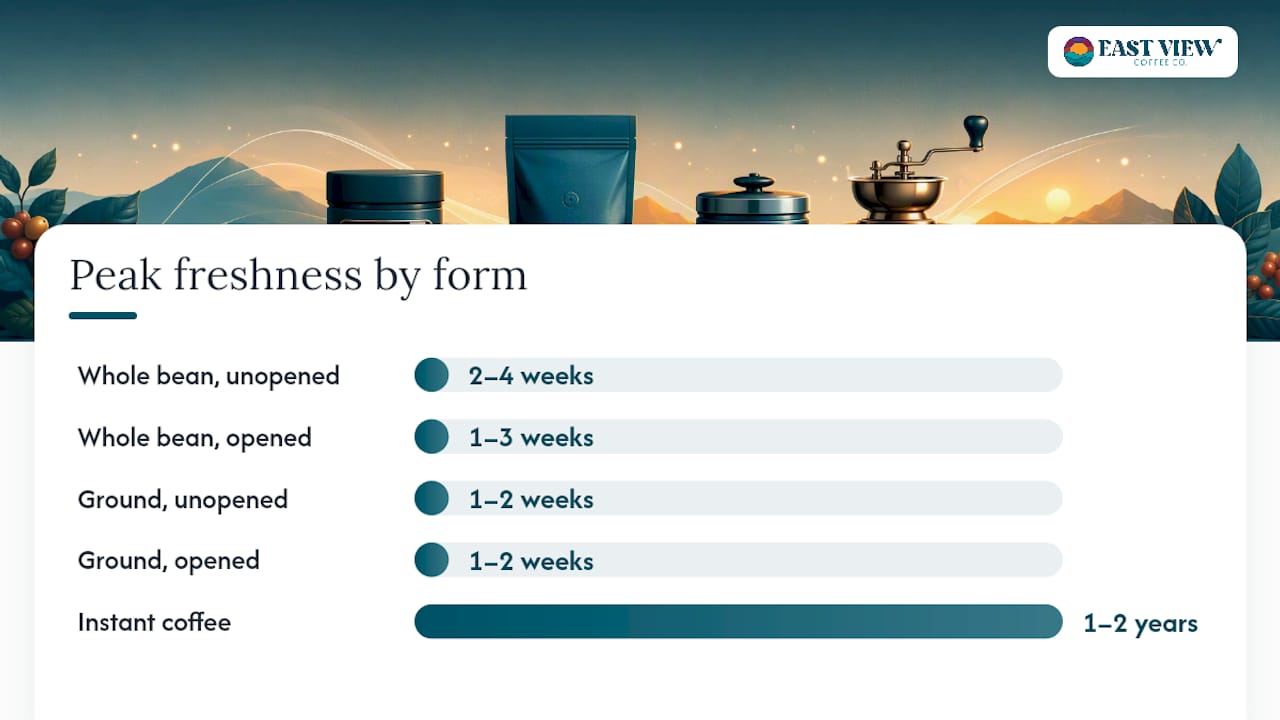
Here is general consumer guidance on coffee freshness windows from credible sources WebstaurantStore and About Coffee.
| Coffee Form | Peak Freshness | Still Good | Technically Usable |
|---|---|---|---|
| Whole bean, unopened | 2–4 weeks post-roast | Up to 6 months | Up to 9 months |
| Whole bean, opened | 1–3 weeks | 1–2 months | Up to 6 months |
| Ground, unopened | 1–2 weeks post-roast | 3–5 months | Up to 5 months |
| Ground, opened | 1–2 weeks | 1 month | 3–5 months |
| Instant coffee | 1–2 years | 2–20 years | Indefinitely if sealed |
| Brewed coffee | Same day | 3–4 days refrigerated | Not recommended beyond 4 days |
Note that coffee past its peak flavor window remains safe to drink, but its quality and taste will have significantly diminished compared to when it was fresh.
Roast date vs. best-by date: Manufacturers set best-by dates based on packaging and storage assumptions, often 6–12 months out. That’s a safety and logistics number, not a flavor number. Serious Eats recommends treating the best-by date as a floor, not a target, and buying smaller quantities more often so you’re always drinking within the peak window.
How to store coffee beans at home
The enemies of fresh coffee are oxygen, light, heat, and moisture. Everything else is secondary.
- Keep beans whole until you’re ready to brew. Grinding is the single fastest way to accelerate staleness.
- Use an airtight, opaque container. A mason jar on a sunny counter is worse than the original bag. Specialty coffee bags with one-way valves are actually well-designed for short-term storage.
- Store at room temperature, away from the stove, oven, or any heat source. A cool, dark pantry or cabinet works well.
- Avoid the refrigerator. The fridge introduces humidity and food odors. Coffee is porous and absorbs both.
- Buy what you’ll drink in two to three weeks. This is the single most effective storage strategy. No container or gadget beats buying fresh.
Pro Tip: If you’re storing beans in their original bag, press out as much air as possible before resealing, and fold the top down tightly. The one-way valve lets CO2 out but doesn’t seal perfectly once opened. Transferring to a small-mouth, airtight container after opening is worth the extra step.
For a deeper look at Eastviewcoffee’s specific pantry storage recommendations, the how to store coffee beans guide covers the full workflow.
Can you freeze coffee beans? The right way to do it
Yes, freezing works. Done correctly, it can preserve flavor in bulk coffee for months. Done carelessly, it introduces moisture and ruins the beans faster than leaving them on the counter.
About Coffee’s storage guidance is clear on the key principle: portion first, freeze once, thaw once.
Here’s the method:
- Divide your bulk coffee into single-use portions before freezing. Each portion should be roughly one week’s worth of beans.
- Seal each portion in an airtight, moisture-proof container or vacuum-sealed bag. Remove as much air as possible.
- Freeze the portions you won’t use immediately. Leave one portion at room temperature for current use.
- When you need a new portion, remove it from the freezer and let it come to room temperature before opening the bag. This prevents condensation from forming on the cold beans.
- Never return beans to the freezer once thawed. Repeated freeze-thaw cycles introduce moisture and degrade flavor quickly.
The biggest freezing mistake isn’t the cold itself — it’s condensation. When frozen beans hit warm air, moisture forms on the surface before the bag is opened. Always let the sealed bag reach room temperature first, then open it. That single step protects the beans from the moisture that causes off-flavors and mold risk.
The refrigerator is a different story. Most storage guides, including Serious Eats, advise against it. The fridge doesn’t get cold enough to meaningfully slow oxidation, but it does expose beans to humidity and odors from other foods. Freezer: yes, with care. Refrigerator: no.
When should you actually throw coffee beans away?
Day9 makes the safety case plainly: roasted beans contain roughly 2–3% moisture, which is too low to support most microbial growth. The real risk comes from moisture getting in after roasting.
Discard beans if you notice any of these:
- Visible mold or fuzz on the beans or inside the bag. This is the clearest sign of moisture contamination.
- A musty, wet, or mildewy smell. Normal stale coffee smells flat or papery. Mold smells distinctly damp and unpleasant.
- A sour or chemical odor that wasn’t there when the bag was fresh. Rancid oils can develop a sharp, almost paint-like smell.
- Obvious moisture damage: clumping, wet spots on the bag, or beans that look swollen or discolored.
Flat, dull, or cardboard-like aroma? That’s staleness, not spoilage. Safe to brew, just not worth celebrating. If the coffee smells like coffee, even weakly, it’s fine to drink.
Whole beans vs. ground coffee: which holds freshness longer?
The difference comes down to surface area. A whole bean exposes a relatively small surface to oxygen. Grind that same bean and you’ve created hundreds of tiny particles, each with exposed surface area releasing CO2 and absorbing oxygen simultaneously.
- Whole beans retain peak flavor for a few weeks after roasting; ground coffee loses freshness much more rapidly after grinding.
- Pre-ground coffee in a sealed bag can stay acceptable for weeks, but it will never match freshly ground beans from the same roast.
- Grinding just before brewing is the single highest-impact habit for better-tasting coffee at home.
That said, convenience is real. Pre-ground coffee makes sense for travel, office settings, or anyone who doesn’t own a grinder. If you buy pre-ground, buy smaller quantities and use them within two weeks of opening. Instant coffee is a different category entirely: its processing removes most of the volatile compounds that go stale, which is why it can sit in a cabinet for years without becoming unsafe.
For more on building a freshness-first purchase habit, the how to keep coffee fresh guide from Eastviewcoffee covers daily routines worth adopting.
What the research and experts say about coffee freshness
The science behind coffee freshness is well-documented. A peer-reviewed analysis published in the ACS Journal of Agricultural and Food Chemistry confirms that roasted coffee’s aroma compounds are produced during the Maillard and Strecker reactions of roasting, and that these volatile compounds degrade progressively after roasting as CO2 escapes and oxygen exposure increases.
The Specialty Coffee Association frames degassing as the defining variable in post-roast freshness: the rapid CO2 loss in the first several weeks after roasting is both what makes very fresh coffee bloom beautifully and what signals the beginning of flavor decline once the gas is gone.
On the practical side, About Coffee and WebstaurantStore both align on the same consumer-facing message: whole beans sealed in airtight packaging last longest, ground coffee loses freshness fastest, and the refrigerator shortens rather than extends shelf life.
A note from East View Coffee Company on buying fresh
At Eastviewcoffee, every bag carries a roast date because that’s the only number that tells you where you actually are in the freshness window. The recommendation is simple: buy smaller batches, more often. A 12-ounce bag roasted this week beats a 2-pound bag roasted two months ago, every time. Small-batch roasting in Kenosha means the coffee moving through the supply chain is genuinely recent, not sitting in a warehouse.
Fresh beans, delivered when it matters
Knowing the science is one thing. Having beans roasted within the last two weeks sitting in your cabinet is another. Eastviewcoffee roasts in small batches from women-owned farms, and every bag ships with the roast date printed on it so you know exactly what you’re working with.
The Delightful Coffee Club single-origin subscription is built around the peak freshness window: regular small deliveries timed so you’re always brewing within that 2–4 week sweet spot. If you’d rather pick a single bag to try first, the community freshly roasted coffee page shows what’s available right now. Either way, you’re starting with a roast date you can actually trust.
Sources
- Coffee Decoded: What is “freshly roasted” coffee? — Specialty Coffee Association
- Best Way to Store Coffee — Serious Eats
- Day9
- Storage and shelf life - Beans - About Coffee
- How Long Does Coffee Last? Storage & Shelf Life FAQ — WebstaurantStore
FAQ
Do coffee beans actually expire or just go stale?
They go stale long before they become unsafe. Roasted beans are low-moisture, so microbial growth is rare unless water gets in. What you lose over time is flavor, not safety.
How long do whole coffee beans stay fresh after opening?
Whole beans taste best within 1–3 weeks of opening, though they remain drinkable for up to two months when stored in an airtight, opaque container at room temperature.
Can you freeze coffee beans to extend their shelf life?
Yes, freezing works well for bulk coffee if you portion beans into single-use airtight packs before freezing and thaw each portion only once. Repeated freeze-thaw cycles introduce moisture and degrade flavor.
Is ground coffee shelf life shorter than whole beans?
Significantly shorter. Ground coffee loses peak freshness within days of grinding because the increased surface area accelerates both CO2 loss and oxidation. Buy pre-ground in small quantities and use within two weeks of opening.
What does a bad coffee bean actually smell like?
Stale beans smell flat, papery, or like cardboard. Beans that have gone bad from moisture smell musty, mildewy, or sharply sour. Visible mold or a chemical odor means discard immediately.