
Coffee and Breastfeeding: How Much Caffeine Is Safe?
Coffee and breastfeeding mix just fine for most mothers and babies. The CDC says low to moderate caffeine, about 300 mg a day, roughly two to three 8-ounce cups of coffee, is unlikely to bother most breastfed infants. LactMed puts the safe range closer to 300 to 500 mg for most mothers, though some doctors recommend a more cautious 200 mg for extra peace of mind.
The exceptions matter more than the rule. Newborns, preterm infants, and babies with medical complications clear caffeine far more slowly, so even a normal maternal intake can build up in their systems.
- General limit: around 300 mg/day (CDC), with 200 to 300 mg as the commonly cited safe window
- Watch closely: newborns, preterm babies, and infants with existing health issues
- Trusted sources: CDC, LactMed (NCBI), and NCBI’s caffeine exposure guidance for pregnancy and lactation
Quick fact: A typical 8-ounce coffee has 80 to 179 mg of caffeine, meaning two cups can already approach the daily ceiling most authorities recommend.
Key Takeaways
Moderate caffeine intake in the low to moderate range is safe for most breastfeeding mothers, but newborns and preterm infants need extra caution.
| Point | Details |
|---|---|
| Daily limit | Most guidance points to 200 to 300 mg/day, with CDC citing up to 300 mg as generally safe. |
| Timing matters | Milk caffeine peaks 60 to 120 minutes after intake, so drinking after nursing lowers exposure at the next feed. |
| High-risk infants | Newborns and preterm babies clear caffeine much more slowly and warrant a lower, more cautious intake. |
| Watch for symptoms | Persistent irritability, jitteriness, or poor sleep are worth a short elimination trial before assuming caffeine is unrelated. |
| Lower-caffeine option | Eastviewcoffee’s half-caff blends, including Cat’s Pajamas Half-Caff, let mothers cut caffeine while keeping their coffee ritual. |
This article is general information, not a substitute for advice from a qualified doctor. Consult a qualified healthcare professional about your own circumstances before acting on anything here.
Table of Contents
- Is Coffee Safe While Breastfeeding? The Science Behind the Timing
- Which Babies Are Most Sensitive to Caffeine in Breastmilk?
- How Much Caffeine Is in Your Coffee, Tea, and Soda?
- Practical Ways to Cut Your Baby’s Caffeine Exposure
- Helpful Lower-Caffeine Coffee Options Worth Trying
- When to Cut Back or Call Your Pediatrician
- Does Caffeine Affect How Long You Breastfeed?
- A Straightforward Take on Coffee and Breastfeeding
- Try a Lower-Caffeine Coffee Without Losing the Ritual
- Sources
- FAQ
Is Coffee Safe While Breastfeeding? The Science Behind the Timing
Caffeine crosses into breastmilk quickly, but only a small fraction of what you drink actually ends up there.
Timing is where things get practical. Caffeine levels in breastmilk typically peak somewhere between 60 and 120 minutes after you drink it, then decline as your body clears it. That window is the reason so much guidance centers on when you drink coffee, not just how much.
Individual variability plays a bigger role than most people expect. Genetics affect how fast your liver processes caffeine through the CYP1A2 enzyme pathway, so two mothers drinking the same 12-ounce coffee can end up with very different caffeine levels in their milk an hour later. How often your baby feeds also changes the math. Frequent feeders get smaller, more frequent doses spread across the day, while babies on a longer schedule might nurse right during that peak window.
- Less than 1% of maternal caffeine dose typically transfers to milk
- Peak milk caffeine levels usually occur 60 to 120 minutes after intake
- Metabolism speed varies by genetics, liver function, and pregnancy history
- Feeding frequency affects how much caffeine a baby actually receives per feed
The evidence here is solid on the general kinetics but thinner on precise, universal numbers. LactMed notes that most research relies on case reports and smaller studies rather than large randomized trials, so treat any specific milligram figure as a helpful estimate, not a hard rule.
Which Babies Are Most Sensitive to Caffeine in Breastmilk?
Newborns process caffeine dramatically slower than adults do. In the first days and weeks of life, a baby’s liver enzymes haven’t matured enough to clear caffeine efficiently, so it can take days rather than hours to fully metabolize a single dose according to LactMed. That’s a sharp contrast to the few hours it takes a healthy adult.
This changes fast, though not instantly. Most infants show noticeably better caffeine clearance by around 3 to 4 months, as liver enzyme systems mature. Preterm infants often need extra time beyond that, since their systems were still developing at birth regardless of chronological age.
What does caffeine sensitivity actually look like in a baby? Reports consistently point to a similar cluster of symptoms when maternal intake runs high:
- Increased fussiness or irritability that doesn’t resolve with the usual soothing
- Jitteriness or a wired, hard-to-settle quality during awake periods
- Shorter naps or trouble settling into deep sleep
- More frequent night waking than the baby’s usual pattern
Older case reports describe these symptoms mainly in mothers consuming very high amounts, sometimes the equivalent of 10 or more cups daily, though sensitivity varies by baby. Controlled studies looking at moderate intake (up to 500 mg) have generally found no significant effect on infant heart rate or sleep duration, which is reassuring for anyone drinking a cup or two and wondering if that’s the reason for a rough night.
Pro Tip: If your baby is under 3 months old and seems unusually wired after your morning coffee, try shifting your cup to right after a feeding instead of right before one. It’s a small change that often makes a noticeable difference.
How Much Caffeine Is in Your Coffee, Tea, and Soda?
Tracking your intake gets easier once you see the numbers side by side. Caffeine adds up across everything you drink and eat in a day, not just your morning cup, so a soda at lunch or a chocolate dessert at dinner counts toward your total.
Decaf isn’t zero. It still carries a small caffeine load, typically 2 to 15 mg per 8-ounce cup, so a few cups of decaf plus a chocolate bar and a green tea can still add up to a meaningful number.
- Add every source together, not just coffee, to see your real daily total
- Energy drinks vary the most, so always check the label
- If your baby is under 3 to 4 months, count conservatively and lean toward the lower end of any range
Practical Ways to Cut Your Baby’s Caffeine Exposure
You don’t have to quit coffee to protect your baby from a caffeine overload. A few small adjustments can shrink exposure while keeping your routine mostly intact.
- Drink coffee right after nursing or pumping, not right before. Since milk caffeine peaks 60 to 120 minutes after you drink it, timing your cup after a feed gives your body more time to clear caffeine before the next one.
- Try a half-caff blend. Mixing regular and decaf grounds cuts your caffeine intake roughly in half without losing the ritual or most of the flavor.
- Downsize your serving. Swapping a 16-ounce cup for an 8-ounce one is an easy way to cut intake without eliminating anything.
- Check labels on everything, not just coffee. Energy drinks and even some over-the-counter medications carry surprisingly high caffeine content that can quietly push your daily total higher than you’d guess.
- Stay hydrated. Caffeine is mildly dehydrating, and staying ahead of fluid loss supports both milk production and your own energy levels.
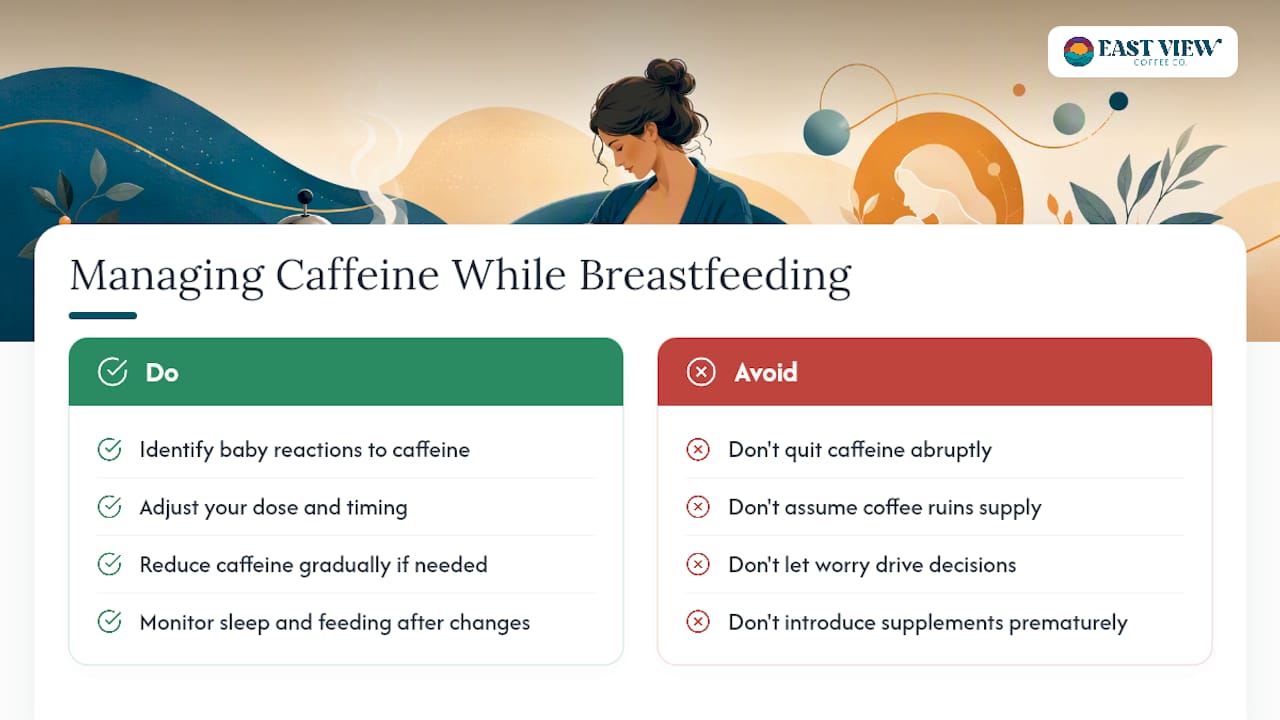
- Taper gradually if you’re cutting back significantly. Dropping from several cups a day to zero overnight can trigger caffeine withdrawal headaches and fatigue in you, which makes early motherhood harder, not easier.
Pro Tip: Keep a small notebook or phone note tracking your baby’s fussiness alongside your own caffeine intake for a week. Patterns show up faster than you’d expect, and it takes the guesswork out of whether coffee is actually the culprit.
Helpful Lower-Caffeine Coffee Options Worth Trying
If you’d rather reduce caffeine without giving up your morning ritual entirely, half-caff and decaf blends solve that problem directly. Cat’s Pajamas Half-Caff Freshly Roasted Coffee blends regular and decaf beans to cut caffeine roughly in half while keeping a full-bodied taste. Half-A$$ed Half-Caff Freshly Roasted Coffee offers a second half-caff option for mothers who want to compare roast profiles before settling on one. The Sunny’s Choice Bundle pairs several lower-caffeine varieties together, useful if you’re still figuring out which blend fits your taste and your caffeine target.
These options come from Eastviewcoffee’s small-batch roasting operation in Kenosha, Wisconsin, sourced from women-owned farms and roasted with eco-friendly practices. That sourcing model matters beyond ethics: small-batch roasting tends to produce more consistent, better-documented caffeine profiles than mass-produced blends.
| Product | Best For |
|---|---|
| Cat’s Pajamas Half-Caff | Mothers wanting a familiar coffee taste at roughly half the caffeine |
| Half-A$ed Half-Caff | A second half-caff profile for comparison shopping |
| Sunny’s Choice Bundle | Sampling multiple lower-caffeine roasts before committing |
A gradual reduction plan works best: start by swapping one daily cup for a half-caff version, adjust your brew strength if the flavor feels thin, and reassess after a week.
When to Cut Back or Call Your Pediatrician
Most fussiness has nothing to do with coffee. But a few signs are worth taking seriously enough to run a real test.
- Watch for red flags: persistent irritability that doesn’t resolve with soothing, visible tremors or jitteriness, feeding difficulties, or poor weight gain.
- Run a short elimination trial. Cut maternal caffeine entirely for 2 to 7 days and track whether symptoms improve. Most parents who notice a real caffeine link see improvement within that window.
- Call your pediatrician if symptoms persist beyond a week of elimination, or immediately if your baby is preterm, a newborn, or already dealing with another health condition. Roughly 300 mg/day is the general ceiling most guidance cites, but that number assumes a healthy, full-term baby, not a higher-risk one.
Does Caffeine Affect How Long You Breastfeed?
One of the more reassuring findings in the research is what caffeine does not appear to do: it doesn’t reliably shorten how long mothers breastfeed or reduce breastfeeding success. Studies looking specifically at milk supply have found no consistent link between moderate caffeine intake and reduced production, even at intakes up to 500 mg daily in controlled research.
That matters because worry itself can undermine breastfeeding duration more than caffeine ever would. Mothers who fear their coffee habit is “ruining” their supply sometimes cut caffeine so aggressively that they deal with withdrawal fatigue and headaches on top of the exhaustion of early parenthood, which makes the whole experience harder to sustain. Nothing in the current evidence supports that trade-off for moderate intake.
Where caffeine can indirectly affect breastfeeding duration is through the baby’s side of the equation, not the milk itself. If a baby genuinely reacts to high maternal caffeine with poor sleep or feeding difficulty, that disruption can make nursing sessions harder for both of you, which in turn makes some mothers more likely to introduce supplemental feeding earlier than planned. The fix isn’t quitting coffee. It’s identifying and adjusting the actual dose, which usually resolves the downstream feeding issues within days.
The practical takeaway holds steady across the research: coffee itself isn’t the threat to breastfeeding success that some mothers fear, but managing dose and timing thoughtfully protects both the nursing relationship and your own sanity.
A Straightforward Take on Coffee and Breastfeeding
The guidance on coffee and breastfeeding is more forgiving than the internet makes it sound. Most of the fear circulating online comes from worst-case anecdotes, not the actual body of evidence, which points toward moderate caffeine being fine for the overwhelming majority of nursing pairs.
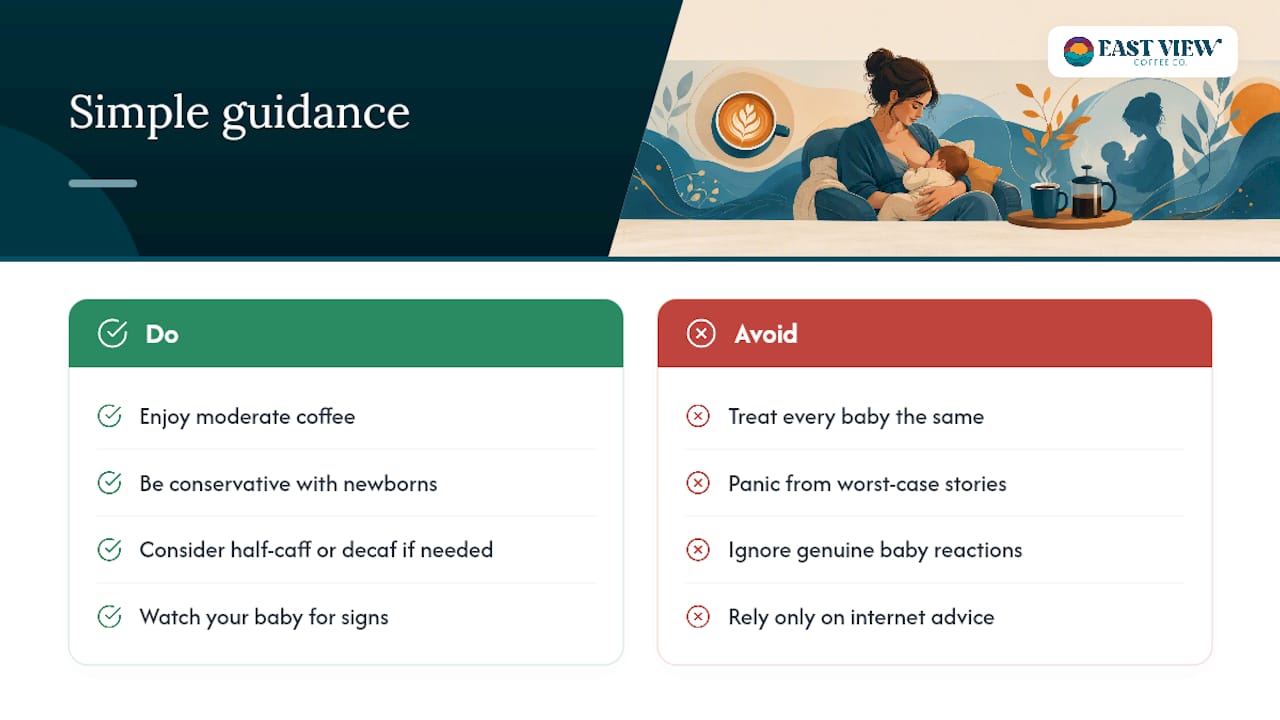
Where I think mothers get tripped up is treating every baby’s caffeine sensitivity as identical. It isn’t. A newborn and a five-month-old process caffeine on completely different timelines, and pretending otherwise leads to either needless anxiety or, less commonly, ignoring a real signal from a baby who’s genuinely reacting.
My honest take: enjoy your coffee. If you’re nursing a newborn or a baby with health complications, lean conservative and consider half-caff or decaf while you wait for that metabolism to mature. Watch your baby, not a spreadsheet. And if something feels off, a pediatrician or lactation consultant can sort out in one conversation what a week of internet searching won’t.
— Jenny
Try a Lower-Caffeine Coffee Without Losing the Ritual
You don’t have to choose between your morning coffee and peace of mind. Eastviewcoffee roasts half-caff and decaf blends in small batches in Kenosha, Wisconsin, sourced from women-owned farms, so you get full flavor with a fraction of the caffeine load of a standard brew.

If you’re ready to cut back gradually, Cat’s Pajamas Half-Caff Freshly Roasted Coffee is the easiest starting point, roughly half the caffeine of a standard cup with the same rich taste you’re used to. Want to compare a few options before settling on one? The Sunny’s Choice Bundle lets you sample several lower-caffeine roasts side by side. Order a bag or start a subscription today, and if your baby is a newborn or has any health complications, check with your pediatrician before making changes to your caffeine routine.
Sources
- Maternal Diet and Breastfeeding | Breastfeeding special circumstances | CDC
- Caffeine - Drugs and Lactation Database (LactMed®) - NCBI
FAQ
How long should I wait to breastfeed after drinking coffee?
There’s no required waiting period for moderate intake, but caffeine peaks in breastmilk 60 to 120 minutes after you drink it, so nursing right before that window means slightly higher exposure.
Can coffee reduce my milk supply?
No consistent evidence links moderate caffeine intake to reduced milk supply; controlled studies of intakes up to 500 mg daily found no significant effect on infant outcomes or production.
Is one cup of coffee a day safe while breastfeeding?
Yes, one 8-ounce cup, roughly 80 to 179 mg of caffeine, sits comfortably within the 200 to 300 mg daily range most health authorities consider safe for breastfeeding mothers.
Does coffee upset breastfed babies?
Most babies show no reaction to moderate maternal caffeine intake, but high intakes have been linked in case reports to fussiness, jitteriness, and poor sleep, especially in newborns and preterm infants.
Does decaf coffee still have caffeine breastfeeding mothers should count?
Yes, decaf typically contains 2 to 15 mg of caffeine per 8-ounce cup, small but not zero, so it still counts toward a strict daily total if you’re being conservative.
Recommended
- Decaf Coffee in Pregnancy: Safety, Caffeine, and Smart Choices – East View Coffee Company
- Decaffeinated Coffee – East View Coffee Company
- Half Caff Coffee How Much Caffeine? How Much Caffeine Is In Half Caff Coffee - East View Coffee Company
- How Much Caffeine is in My Coffee? – East View Coffee Company